
“The philosopher Leibniz showed that the world is made up of series which are composed and which coverage in a very regular way, according to ordinary laws. However the series and the sections are only apparent to us only in small sections, and in a disrupted or mixed up order, so that we believe in breaks, disparities and discrepancies as in things that are out of ordinary.” (Cinema 2, pg.14) Cinema has mainly been the action-image spectacle of extraordinary because of its use of breaks and discrepancies in recreation of real life. It has primarily depicted events discretely. However some filmmakers such as Ozu, and Michel khleifi in the case of The Fertile Memories (1980) have tried against that by raising the emphasis on the mundane everyday banality, along with using strategic cinematic techniques: Camera movements are minimum, and mainly in the form of slow panning shots. Close-ups and deep depth of field have been constantly used. Dissolves are abandoned in order to make room for the simple cut. Empty spaces (both exterior and interior) and silent moments; occupy a good amount of screen time. The montage is somewhat rhythmic with low tempo, creating a certain temporal calmness.
Also in search of a more continuous recollection, by a particular way of gluing the sound to image, Khleifi has tried in reducing the affect of discreteness of film. The sound often continues to the next shot, be it an absolutely different environment. Or sometimes what seems to be a voice over narration becomes the actual onscreen sound of the shot that follows. This perhaps has been an attempt in reproducing the “pure” memory. Deleuze writes on Bergson’s notion of memory: “On one hand the following moment always contains, over and above the proceeding one, the memory the latter has left it; on the other hand, the two moments contract or condense into each other since one has not yet disappeared when another appears. “ (Bergsonism, pg. 51) In The Fertile Memories, sound acts on a higher level, as a linkage that merges the images together. In overall, reproducing memory in a sense that each segment would contain the proceeding one, and would not necessarily disappear with the arrival of a segment that follows.
Therefore considering khleifi’s way of editing in creating a sense closer to pure memory, the importance given to the everyday banality, and also the singularity of the separate narrations of the two women, he’s approach to history can be viewed as a genealogical one. By showing the everyday life, Khleifi “reveals disparity and dispersions” of the identity of the women, which would have regularly been cut out.
References:
• Deleuze, Gilles. (1991). “Memory as Virtual Coexistence.” Bergsonism. New York: Zone Books.
• Deleuze, Gilles (1989). “Beyond the movement image.” Cinema 2 : The Time-Image. Minneapolis: University of Minnesota Press.
• Foucault, Michel (1984). “Nietzsche, Genealogy, History.” The Foucault Reader. New York: Pantheon Books
November 01, 2009
Memory and the Everyday life in Fertile Memories

September 04, 2008
Spiritual Impression of Time in The Diary of a Country Priest
In order to have a thorough understanding of Bresson’s style, particularly in The Diary of a Country Priest (1951), it is crucial to study the film through the perspective of time. Bresson’s treatment of time in this film is very different than that of the typical narrative cinema. He provides his audience an unusual impression of time; one that removes any sense of real-time versus onscreen-time relation. Philip Lopate describes his first viewing experience of the film:
Suddenly I had the impression that the film had stopped; rather, that the time had stopped. All forward motion was arrested and I was starring into eternity. Now, I am not the kind of person, readily given to mystical experiences, but at that moment I had a sensation of delicious temporal freedom (Lopate, 27).
What Lopate calls “delicious temporal freedom,” is the spiritual sensation that transcends any notions of real-time; a sensation that is achieved by a multiplicity of temporal, and non-temporal effects. A multiplicity that slows down all the bodily and mental processes and prepares the spectator for the use of intelligence at the correct moment. Unlike Brechtian distanciation this multiplicity, does not disregard emotions, rather, as Sontag puts it, disciplines them (Sontag, 59).
The most significant way in which Bresson treats time is through editing. He places the cuts at the exact moments, highly uses dissolves, fade-ins and fade-outs, but never abuses them. He creates certain unique tempos and rhythms, and then in a larger scale collages different ones skillfully together. Most scenes in this film are cut short. Bresson never leaves any unnecessary extra time within a scene. He takes you right at a point of a conversation that is important, and doesn’t leave any room for extra dialogues. By this he achieves a minimalism that frees the film from any extra cliché , focus the attention of the spectator on the key elements of the novel, and presents every scene with an equal importance to the narrative structure.
In The Diary of a Country Priest Bresson repetitively uses dissolves. This consistent use of dissolves gives the film an exclusive temporal sensation, and creates a flow, that blurs the boundaries between separate shots and slows down our impression of time. The experience of specially first thirty minuets of the film is perhaps temporally very disorienting. The combination of the dissolves and short scenes, creates this effect that on one hand the experience of onscreen time would seem very slow, and yet relatively to the real-time fast. In other words when watching the first thirty minuets of the film, the movie would feel to have a very slow pace, however one would never guess that s/he has been sitting through half an hour of it. That is because the story is uncovered very fast, while a multiplicity of aesthetics slows down the impression and affect of it.
The constant use of dissolves also gives the normal cut a new effect: the power to accentuate. Because of the dissolves that have been used frequently, in times a cut gains such a disruptive power that it breaks the flow of the editing rhythm, and consequently results in a powerful self-reflective focusing of attention of the audience. For instance, when the country priest meets the priest of the Torcy in the hut, the scene opens with a fade-in, a cross dissolve from black to a long shot of the two men from back. This shot dissolves into a medium shot of the two men inside the hut both facing one direction yet talking to each other. This shot is kept, and it cuts to a reverse angle shot only before the priest of Torcy delivers the line: “you don’t pray enough, you suffer too much to pray. That’s how I see it.” At this point Bresson adds a dolly in towards country priest’s face, reframing him in a close up, when he replies with guilt: “But I can’t pray.” This cut does not provide us any new visual information. It only switches the orientation of the two characters in respect to the camera. Therefore because of the dissolves that precedes this cut, and also the very minimal visual differences between the two connecting shots, this cut appears much more radical than a normal cut, and highlights the part of the conversation that follows it.
One of the critical techniques that Bresson uses in the treatment of time is compression and expansion of onscreen time with relation to each other. He compresses time in the sense that he eliminates some parts of the action within a shot, mainly transitioned by dissolves. For instances in the scene where the priest visits the specialized doctor in Lyle, we are only shown the doctor’s sign which is dissolved into a shot of the priest leaving the clinic. What happens behind the doctor’s blurry doors is too significant to be eliminated. However by doing so, Bresson achieves three effects; First he avoids an emotionally climactic scene where the priest learns about his cancer. Second, he creates a sense of suspense that awaits the audience for the result of doctor’s diagnosis. And third, he compresses time, by not showing us a period of time that its existence is surely indicated to us.
Another way, in which Bresson is able to compress the experience of time, is by starting a scene from a central point of a conversation, long after the actual beginning of it. In several occasions he just throws the audience in a middle of a conversation, and emphasizes this fact by a line in dialogue. For instance, in the scene where the priest meets the countess for the second time, without and introduction or preparation, Bresson takes us to a significant part of the discussion: the priest expressing his worries for Chantal’s suicidal tendencies. As audience, we are aware that such a line could not have been delivered without any conversational build-up, and as a result, subconsciously become perceptive of the undepicted time. By this technique not only Bresson gives time a new sense within the shots’ relation, but he also achieves what his known for as a minimalist: the elimination of the unnecessary segments, and accentuation of the key points.
Bresson also manages to expand time by very fine techniques. A major method through which he expands audience’s sense of time is the use of the voice over narration. In many parts the voice over narration exceeds its position as a verbal reading of the diary, and becomes a subjective reflection of priest’s thoughts. A good example of how employment of such method would expand time, is the scene where the priest of the Torcy, visits the priest in his home. When the priest of Torcy commands the country priest to sit down, a low angle shot of the priest of the Torcy is cut to a reverse shot of the country priest, depicting him from a slightly higher angle. While his eyes stare at a point near the camera, he says “No.” Then he closes he eyes, followed by a very gradual dolly in camera movement. During the dolly in, a voice-over narration, which can be regarded as a reading of the diary, presents us the country priest’s inner feelings. In this segment of the scene, which lasts for about ten seconds, both characters are silent, in order to create room for the voice-over. This break within such important ongoing conversation, gives the impression that the time has stopped in order to expose us to the priest’s subjective feelings.
The Diary is an absolute key narrative and mise-en-scene element that creates a continuous flow and connection between different shots, forms a unique temporal quality, reveals priests subjective inner conflicts, and establishes an association to Bernanos’s adapted novel. Bresson juxtaposes the diary shots in a way that it mesmerizes any sense of their temporal position within the narrative. In most cases it is very hard to realize, at what point of the timeline it is that the priest is writing down his thoughts. In some parts we see him writing down his reflection of a scene that just preceded it, in some other parts we see him reflecting on the state he is in at that moment, and in other parts he writes about an action that is going to appear on the screen later on. Therefore the relation between the temporality of the diary shots, and the narrative time, is not fixed.
On the top of the visuals the voice-over as well contributes to the diary’s temporal ambiguity. The voice-over appears in four different kinds of relation with the image. In some scene the voice-over starts in a shot prior to that of the diary and continues through the shot of the diary and matches the diary. Sometime the voice over starts with the depiction of the diary and ends as the shot ends. In some other scenes, the voice over reads the diary and then continues through the next shot, as if the shot of the diary has been a flash-forward. In many scenes without any depiction of the diary we get the voice over explaining to us the priest subjective thoughts.
Considering Bresson’s interest in the interior conflicts of characters he uses the diary as a tool to demonstrate the priests inner feelings. But using the motif of the diary, Bresson detaches any sense of omni-science voice over narration, and transforms the voice over into readings of the diary, a more intimate subjective approach to the matter, through the point of view of the priest. In several points he even uses the diary as a visual tool to depict the priest’s feelings. For example, Bresson provides us the image of the priest tearing out some of his diary’s pages, which indicates his regret for some of his misjudgments, or later in the film where he is leaving the country for Lyle we see he packing his all his diary notebooks while Chantal is there, which somehow implies his guard toward his privacy, and his fear of Chantal’s interference in his private life.
Bresson has been well known for his use of sound in cinema. In The Diary of a Country Priest sound serves as a major element, influencing the overall impression of time and performances. In this film Bresson avoids using any ambient sound, therefore any onscreen or offscreen sound would seem isolated. This effect not only triggers a self-reflective response, but contributes to the minimalist touch of Bresson as well. It also gives the film certain quietness that perfectly matches the rhythm and the flow produced by editing, and also the performances and gestures.
The digetic offscreen sound in this film has been skillfully utilized to avoid certain visual redundancies, set a particular mood, and to produce the doubling effect. Bresson uses the offscreen sound to avoid any superfluous image that might add a climactic feel, or disrupt the narrative flow. For example, before the priest learns about the death of the country doctor, we hear an offscreen sound of a gunshot, while the priest is walking with his bike in the countryside. It is only in the following shot that we are hinted about the source of the shot. This way the narrative element is there, while the harsh image is concealed.
Bresson invest a great attention in keeping a consistent use of the camera. The camera movements, camera angles, and the depth of field of the shots has been carefully chosen and kept in a consistent fashion that has created a language of its own. Every time we are exposed to the priest’s inner thoughts we are provided with a dolly in camera movement. The camera often moves in a very subtle way. Sometimes the movements are very minimal yet effective. These delicate camera movements are another key element in shaping the way spectator experiences time. They blend perfectly within the flow that has been created by editing, and contribute to the process of slowing down the experience of time.
The camera angle has been used very cautiously is suggesting the amount of authority. Those who are in a higher position, or in control of a conversation are always shot from a lower angle, than the other. More interestingly, in several scenes as the conversation carries and the authority of characters shift, the camera angle also changes accordingly. For example when the priest meets the countess for the second time, we have this constant shift of control over the conversation. In times the countess seems to be the one in control, but as the issue of her dead baby is brought up, the priest gains a more authority over the conversation. Bresson brilliantly changes the camera angle depiction of the characters by the having them sitting and standing through the conversation. That is, while they talk seated, they are depicted from a high angle, and when stood up, from a low angle.
It has been said that Léonce-Henri Burel, who was the cinematographer for this film has only used a 50mm lens throughout the film, in order to have a higher control over the depth of field, and maintain a consistency over the film. Most shots in The Diary of a Country Priest are in a medium range of depth of focus. We rarely get any shots with a deep or shallow focus. By this steady way of treating the depth of field, Bresson focus our attention on certain characters or objects that are in focus, and he provides only a slightly blurry milieu surrounding the character. The surroundings are out of focus to the degree that they can be identified, yet not receiving any particular attention.
Susan Sontag mentions the Brechtian Aspect of the performances, but on the top of the self-reflective effects of the performances, there relies a more temporal effect that is mainly dependant on movements and gestures. Bresson has directed all actings, body movements, and gestures in way that they perfectly complement the rhythmic flow of the film. Apart from few exceptions we are never given a fast, or aggressive body movement. All gestures are executed is a meditated way. That does not mean they are necessary slowed down, rather, there has been a great attention to the micro movements within movements. The movements of the eyes, specially those of the priest, carry a lot of the expressions’ weight. They tell us a lot about a person inner conflict while the rest of their face is rather less expressive.
As argued above Bresson uses a multiplicity of elements, in achieving an affect that disorients our notion of time, and challenges our cinematic viewing experience. This multiplicity which is the result of skillful editing, sound treatment, camera movement, body choreography, along with some narrative elements and techniques, gives the temporal form of this film a meditative, spiritual and self-reflective feel; One that perfectly compliments the theme of its content.
References:
Susan Sontag, “Spiritual Style in the Films of Robert Bresson” Robert Bresson. Ed. James Quandt. Toronto: Cinématheque Ontario, 1998. 57-72.
Phillip Lapote, “Films as Spiritual Life” Film Comment. v. 27, n. 6, Nov 1991. pg. 26-30.

May 21, 2008
Kikujiro

In Kikujiro, the narrative structure is fairly different than the typical three act narrative form. Kitano unfolds his story in chapters and segments. Kitano mentions the reason for this structure in an interview himself:
I gained the strong impression that this film didn’t have the turning point or decisive narrative moment that my other films have had- you could watch the whole thing without feeling that any particular scene was crucial in terms of the overall shape.
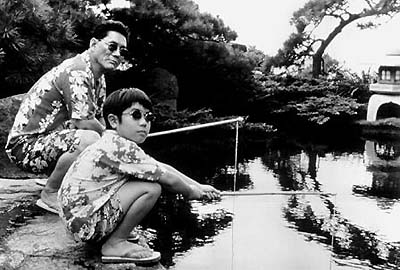
Each chapter begins with an illustrative introduction, in which a particular image representing the chapter is decorated as if it is part of Masao’s diary. That is how Kitano wants us to read the film: as a boy’s summer adventure – a story that is somewhat told from Masao’s perspective.
However, on another level of analyzing the narrative form, the film can be divided into two major segments: before and after the moment where Masao meets his mother. This scene does serve as a turning point. Before meeting Masao’s mother both his and Kikujiro’s motivations were to find her. Once they meet the mother and Masao feels rather unwanted, their motivation shifts. Now it is quite ambiguous what their motivation becomes after this moment. For Kikujiro and other adult characters, cheering Masao eventually becomes the driving force and the objective. From this point onwards the narrative gains a more freedom to maneuver. The characters become more entertaining and less bounded to the restrictions that a story might imply. The film eventually becomes a selection of jokes, games and amusing tricks that don’t necessarily follow logic, and are juxtaposed delightfully in an emotional milieu, as if they are part of a boy’s memoirs.
Even though this is a road movie, there is no precise indication about when the actual trip begins. Kitano avoids providing his audience with any reference to neither time nor place. We can vaguely guess how many days the whole trip took, or how far they traveled, not being precisely familiar with the geography of Japan. It is indicated verbally, in the dialogue when the trip begins by Kikujiro’s wife, yet visually it is only after the first gambling scene that we get to see Kikujiro and Masao in a place that is certainly not home, but also doesn’t very much look like a hotel as well. Also by avoiding to provide us with road shots of them traveling to this place, we are left in this bewilderness of whether the journey has already begun or are they still in Tokyo, just spending the money. With these smooth touches Kitano creates a transition between the scenes prior to the trip and the ones during it that almost makes the beginning of the journey seamless.
What shape the narrative structure of this film more than anything else are Kikujiro and Masao’s relationship, and how their characters contrast each other. While Kikujiro threatens, curses, bullies everyone and has a violent attitude, Masao is calm, polite, and obedient. Masao has this strong motivation of finding his mother, and Kikujiro is conceived perhaps somewhat unmotivated. Kikujiro is a middle-aged man with a violent tattoo on his back, whereas in contrast, Masao is portrayed as a cute innocent boy. Kitano perhaps does over-exaggerate this contrast. For example the way Kitano establishes a comparison between Masao’s character in the beginning of the film and other kids of his own age, is an attempt to maximize his innocence, and emotional empathy that the audience might have with him. On the other end, Kikujiro is involved in numerous acts of violence. The image of his face covered in blood is perhaps one of dominant graphical moments of the film.
Looking at the relationship of the two characters, it is likely to say that Kitano is trying to establish an impression that implies a father-son relationship. This is indicated several times within the film, and Kikujiro himself points it out in the form of a joke, to Masao. However, considering Kikujiro’s naïve childish character, Kitano also places scenes within the narrative that suggest, Masao taking care of Kikujiro. For instance after Kikujiro’s fight in the fun fair, when he is covered in blood, Masao desperately searches for first aid material, and cleans Kikujiro’s face. Now this is a very symbolic act, and it not only portrays an emotional connection between the two characters, but also suggests Masao’s thoughtfulness and caring qualities, over Kikujiro’s naïve inner-child. The way they are represented in this scene, gives the impression of Masao being the adult and Kikujiro the child. This notion can be felt through out the film. Comparing Masao’s and Kikujiro’s solutions for getting a ride can be another evident example; where Kikujiro’s attempts are mean and rude, Masao seems to have a much more civilized approaches.
A narrative process that is very likely and favored in the road movies is the transformation of characters, throughout and because of the trip. In Kikujiro this seems to be the case mainly for Kikujiro comparing to Masao, even though it is Masao who is basically the main subject, and motivation for the trip. A direct example of this would be Kikujiro visiting his mother, after Masao’s failed attempt to reunite with his own mother. A clear parallel can be made between the two incidences, and the way in which in both scenes they get to see their mother from a distance and avoid an actual confrontation. Therefore Kikujiro’s visit to his mother can be viewed as result of the reflection of earlier incident in him.
The film has a beautiful touch in terms of its sense of humor. Kitano has managed this connection with his audience by formal techniques that go beyond the content of the narrative. First he does it through editing. Many of the humorous events function simply because of the way images are juxtaposed, and how the relation between them has been established. For example, in the second part of the bike races scene where Masao’s predictions doesn’t turn out to be accurate, we get this constant switch in picture between the boys wrong predictions and failing of the desired bikers. Another example would be the swimming pool scene: Kikujiro first claims that he knows how to swim, he jumps and then swims ridiculously with a tube around his waist. From this shots, which depicts a lot of activity, Kitano cuts to a static shot of Kikujiro upside down in the pool. This stasis provides us with a sense of humor that is beyond the content of the image, and rather a result of wise juxtaposition.
Even though Kitano has tried to produce a less violent picture comparing to his other films, his temptations in adding elements of violence can be yet felt. It is true that he has cut out the direct scenes of violence, and fights, but the evidences of violence exist through the film. For instance, Kikujiro’s character is indeed a very violent one. He constantly shows an attitude towards different people, curses and participates in the acts of violence. He seems to be only obedient to his wife, who sets the trip and forces him to help Masao find his mother. Some characters react conservatively and some violently to his big mouthing.
Kitano smoothens the level of violence in this film using three techniques. First he does it through framing and editing of the scenes of violence. He either lets the violence happen off-screen, or simply has cut the violent scenes out. For instance in the fun fair scene, when Kikujiro and Masao are participating in a game, and throwing rocks at rewards, all we get to see is their feet, standing on stones. Therefore even such action that is less violent in a direct sense has been hidden from the camera. This shows how Kitano is aware of the impact of gestures, regardless of what narratively they imply.
The second method he uses, is balancing the violence mainly expressed through Kikujiro, by other characters, and particularly Masao. As described before, there has been a great effort to show Masao as an innocent cute boy. Next to Masao we also have “Traveling Man” who is depicted as a relaxed, hip person. Even the two chopper bikers who are expected to be though guys, are considerably naïve and obedient.
The third element is perhaps the music sound track. Even though I believe it is too droning and melodic, and its constant repetition, makes it somewhat frustrating, but it does serve in the favor of smoothening the overall impression of the film.
A certain element that is highlighted through out the film, through both mise-en-scene and sound, is the notion of angel. The film begins with the sound of the “angel bell” while Masao is running carrying the backpack with wings that was given to him by the young couple later in the movie. Kikujiro gives Masao the “angel bell” after the failed attempt of reuniting with the mother. This perhaps is to suggest the feeling of the boy towards Kikujiro and others that they meet on the road. Masao probably viewed these people as his guardian angels, and the people who take care of him, regardless of their senses of irresponsibility and immatureness.
By moving beyond a simple plot, developing an interesting narrative form, and by establishing an odd or rather unique relationship between the two main characters of the film, Kitano has taken a courageous conventional step from his typical violent films, and has created a road movie. The sense of humor, which is a result of skillful formal juxtaposition, along with the whole feeling of the film, that implies somewhat a boy’s perspective of life, have distanced it from a violent tragic drama. At the end looking back at the multiplicity of all the different elements and techniques, we can see how they function together to create an amusing and at the same time touching film.
February 05, 2008
Band of Outsiders

The film takes place mainly in the outskirts of Paris, in winter. The harsh raw portrayal of Paris suburbs, distances this film from the typical summer romantic clean Paris images. The cloudy, dirty wintery roads and the harsh existence of materials such as the cable spools in the muddy industrial ‘other side of the river’, all together contribute in setting the appropriate atmosphere.
The realness of the images leaves an impression similar to that of documentary films. Almost all of the scenes are shot in real locations. It is event that through out the most of the film, natural lighting has been favored very much. Using the available sunlight, Godard has carefully composited his images, in a way that elements still serve their function. For instance in the English classroom scene, the black board is placed between the two windows, in a way that, when the teacher stands in front of it, facing the class, the light coming from the windows shines on her back which creates a soft light and glorifies her and stresses her posh gesture.
The make-ups are minimal, and they have been done in a seamless fashion, so they won’t drag much attention, remain consistent within the films realness qualities, and function in depicting characters. For example Odile’s make-up is reduced to black-eyeliners, which helps in creating an emphasis on her eyes; what she uses a lot of times to express herself. Odile’s short bangs and hairstyle along with her costume which is very identical to school uniforms, portrays her naïve and childish image. Comparing Arthur and Franz’s appearances, an impression of their differences can be felt. While both are clean cut, Franz seems more fashionable, formal and uptight, especially considering his styled hair cut, and athletic body. On the other hand Arthur’s comfortable, normal clothing and his short hair, suggests rather coolness in his portrayal.
One of the key mise-en-scene elements, seen constantly throughout the film, is “the car” that Franz and Arthur ride. Many of the character dialogues take place in the car. The fact that the car is a topless convertible creates an interesting composition setting, where the background of the characters is a constantly changing sight of Paris. On another level the car also contributes to the narrative: when Franz, Arthur and Odile are riding the car with its roof off in the rain, A kind of bizarre abnormality is presented.
Another important mise-en-scene element, which has been used very frequently, is mirror. The main implication of mirrors is mainly to widen the range of view within the frame, but in Band of Outsiders it is also used in helping character development, and narrative indications. Odile constantly checks herself in the mirror, whether it is the small mobile one that she carries, the one on the wall in the cafeteria, or the one in the cafeterias restroom, which is to suggest Odile lack of self confidence and at the same time a kind of teenage narcissism. We also get to see Mr. Stolz’s jacket in the tall mirror placed next to the closet containing the money; The same jacket that later on causes the setback, and as the result a change, in their rubbery plan.
The character movements and positionings has been well planned in most scenes, and their added value to the narrative is worthy of note. For instance the exchange of the drinks in the cafeteria; the never ending dance, that all three of them strangely do it very well in harmony; or the way they roam around the house with their face covered in black socks, in the scene where they enter the house for the first time. They almost seem to mesmerize the camera, which remains at one place and only tilts and pans to follow their fast enterings and exits.
It is very likely to say that an essence of Brecht’s epic theater is sensible in the actors’ performances. According to Britannica Encyclopedia Epic Theater or Brechtian distancing:
“[…] Blocks audiences’ emotional responses and to hinder their tendency to empathize with the characters and become caught up in the action. To this end, Brecht used “alienating,” or “distancing,” effects to cause the audience to think objectively about the play, to reflect on its argument, to understand it, and to draw conclusions.” 1
The acting style, narrative structure, character motives and dialogues all suggest that Godard was not interested on the psychological believability of his characters. The alienating effect is evident through out the film and its tension in some points is highlighted, and prevents us from emotional involvement and reminds us of the cinematic qualities of the film; acts such as Odile’s feeding the tiger; her stare in the camera; the ride in the roofless car with wet windshield and operating wipers, while there are no evidences of rain; Arthur’s very realistic long reaction to fake mockery Franz’s hand-gun shots; the one minuet of silence which totally cuts off the sound and mixes the digetic and the non-digetic worlds; or perhaps Arthur’s gun fight at the end with his uncle where he receives dozen of bullets, and only dies after he kills his uncle with only one shot.
In terms of the narrative structure, Band of Outsiders follows a simple plot, which is based on Fool’s Gold novel by Dolores Hitchens. What makes the film interesting is Godard’s juxtaposition of odd events in between the storylines. He develops his characters with care without giving too much away, and maintaining their ambiguity.
All characters face a transformation as their roles develop and they get closer to their objectives. Odile, which is first, portrayed as a naïve, uncertain teenage schoolgirl, eventually turns into an assistant in the crime, and reveals the adventurous side of her. Yet at the end when the both robberies fail, she expresses frustration and regret.
Franz and Arthur have almost the same motives. Both of them are after Mr. Stolz’s money and both fancy Odile. While Franz is in love with Odile and therefore is tongue-tied around her, Arthur, whose intention towards her is rather that of lust, seduces her with his smoother flirtatious language. As the robberies fail Franz and Arthur’s real intentions toward her get revealed. While Arthur turns into a cynical tempered character that blames Odile harshly, Franz shows his kindness and calms her down.
One of the interesting features of Band of Outsiders is the third person omniscient narration, which is done by Godard himself. The disjointed Narration covers a wide range of approaches in different scenes. He sometimes uses an ironic and humorous language, while being poetic at other times. At times it expresses character’s inner feelings, or provides absolutely unnecessary statements, or rather leaves comments on the cinematic aesthetics of the film. Godard’s fine line of humor in the narration creates a sense of parody of the typical Hollywood third person narrations.
The film includes a series of playful set pieces, which as narrative techniques function along the Brechtian distanciation, to create the interesting character ambiguity, and also the odd unusual nature of events: the long citations of Shakespeare’s “Romeo and Juliet” in French, in the English language class; the symbolic race in the louver museum, and shown particularly, in the classical paintings section, which is a humorous demonstration of the absolute ignorance towards ethics and standards; the repetitious never ending dance; Frantz’s pause in the midst of the robbery to swipe a book;
Placing the film within Thompson’s four-part structure, in the first act Odile, Franz and Arthur’s relationship with each other are exposed. Also their main motive as protagonists, which is to rob Mr.Stolz’s illegal money is introduced. The first act ends as the three main characters leave the English class, with humorous Godard’s voice-over narration over the images, explaining why the actual act of leaving the class has been cut off. In the second act the characters are developed as they plan the robbery, and at the same time hang out in a cafeteria and call off the night with a coin toss, which decides a person between Franz and Arthur, that Odile would spent the rest of the evening with. This leads to the first major turning point at almost the halfway mark, which is the departure of Odile from Arthur’s place, and his struggle with his uncle over the informations regarding the money. The first attempt of the robbery, which fails, leads us to the climax, which ends the third act. After the verbal talk between Arthur and Odile, which upsets Odile, the turning point between the third and the fourth act is indicated by extreme long shot views of the Paris landscapes, with voice over narrations on the top. In the fourth act the film concludes with the second robbery attempt, which also does not go very well. By the end the film ties up all the loose strands and leaves no unanswered plot questions, or unclear issues.
Godard has used all the available resources, to create the appropriate mise-en scene, and craft the plot. He has shown that it is possible to create an interesting image using basic available raw martial, simply by integrating them within an interesting yet questionable composition, also inserting unexpected elements in the narrative structure, and Brechtian Distanciation, in order to produce something far more remarkable than a typical gangster film.
1 "epic theatre." Encyclopædia Britannica. 2008. Encyclopædia Britannica Online. 9 Jan. 2008

December 01, 2007
Zizek, Casablanca and Post-Code Hollywood
Watch the Video Here
Slavoj Zizek is a Marxist/Lacanian psychoanalyst. His psychoanalytic observations of Cinema is very interesting and different. In this video he briefly talks about Casablanca, one of those mediocre Hollywood hits that to my opinion has been over-rated. He also approaches the Post-Code Hollywood censorship, on the level of its subconscious affect.
I really encourage you to check other Zizek videos on youtube. There are two full length features also called: the reality of the virtual and Zizek, that are really interesting.

November 30, 2007
My Man Godfrey and The Great Depression
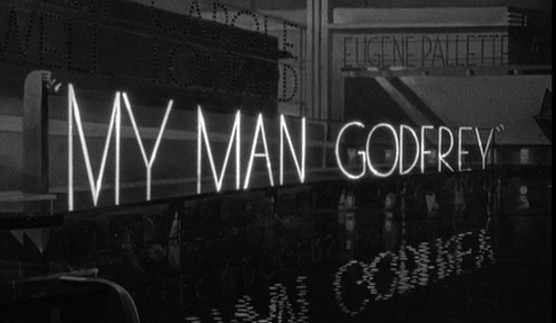
The Depression’s social consequences, such as unemployment, bankruptcy, poverty, and clashes of social classes, are some of the main elements that shape the narrative. My Man Godfrey looks at the Depression from the perspective of the rather elite class. On one hand the film is extremely critical of the high society and it represents them as “empty-headed nitwits” through a comic portrayal, and on the other hand it reveals the people in the dump, who are tagged “forgotten” by the rich, as what Godfrey (William Powell) calls: “the society of really important people.”My Man Godfrey is formed around the comic divergence of Godfrey Parks with the negligent upper-class Bullock family. The Bullock family is symbolized as the mindless partying, irresponsible elite who belong to a class that are too occupied by leisure and are somewhat the answer to the unemployment. Mrs. Bullock (Alice Brady) is portrayed as an unintelligent “amusing” person who supports his protégé Carlo (Mischa Auer) , a pianist whose responsibility in the family is rather that of a royal joker. The cold monstrous older daughter Cornelia (Gail Patrick) is described by Godfrey as:
the Park Avenue brat. A spoiled child who's grown up in ease and luxury, who's always had her own way, and whose misdirected energies are so childish... that they hardly deserve the comment even of a butler on his off-Thursday.
The childish and naïve Irene (Carole Lombard) steals a horse from a cab and leaves it in the family library. Mr. Bullock (Eugene Pallette) however seems to be the most rational of all, yet a shareholder whose mediocre understanding of the stock market almost results in his bankruptcy.
The bullock family’s involvement in the scavenger hunt is also to emphasize their idiocy. The inanity of the game and their treatment of the poor illustrate the boredom and silliness of the high society of the time and comically criticize its snobbish intellectualism. The scavenger hunt creates a contrast between the two extreme social classes, the poor in the dump and the elite. While the rich are in search of “something that nobody wants-a forgotten man” just as a matter of amusement, the poor must also scavenge among the rubbish, rather as means of survival. The destiny of those who participate in this game is clear, when Irene explains to Godfrey that not all of them are hunters, but some are receivers, he suggests: “Sounds like a bankruptcy proceeding.”
The film criticizes the wealthy class and holds them somewhat responsible for the misfortunes of the poor, not because of their wealth but rather their arrogant, irresponsible behaviors. For instance in the scene where Godfrey for the first time as the butler serves Mrs. Bullock’s breakfast, she is unable to recall him:
- What's your name?
- Godfrey.
- Are you someone I know?
- We met last night at the Waldorf Ritz.
- Oh, yes, you were with Mrs. Maxton's party at the bar. Or were you?
- I'm the forgotten man.
- So many people have such bad memories.
It is suggested that people like Godfrey have become “forgotten” mainly due to the negligence of the ignorant upper class that are deeply involved in their leisure life. Another example would be Mr. Bullock’s suspicious first encounter with Godfrey. Even though Godfrey is well dressed and relaxed, Mr. Bullock identifies him as a burglar, which indicates not only Mr. Bullock’s suspicious nature but also his superior power over Godfrey. Cornelia’s constant act of humiliating Godfrey to the extend of setting him up for a theft of her pearl necklace, was also along the lines of snobbish higher class cruelty towards the poor. Even Irene, who is in love with Godfrey, finds herself in a superior position over him. She stubbornly obliges Godfrey to love her throughout the film and at the end she marries him by force. By mostly framing her higher and on the left of the Godfrey, the dynamic forces of power are suggested.
The film is also critical of the government interference in the crisis, and shows a preference for laissez-faire instead. In the very opening scene a tramp complains to Godfrey about the police intrusion in his business: “ If them cops would stick to their own racket and leave honest guys alone, we’d get somewhere without all this relief and stuff.” We see that at the end the survival of the forgotten men from unemployment is because of Godfrey’s project which does not involve any welfare or governmental funding. My Man Godfrey also deals with the notion of tax in wealthy families. In the scene where Mr. Bullock warns the family about their spendings, so that he would be able to pay the taxes, the family reacts to the high percentage of the tax taken by the government. Mrs. Bullock argues: “Well, why should the government get more money than your own flesh and blood?” what is evident in this scene is that the wealthier families are also being effected by the Depression, where at the time it is not taken seriously by the family members, as they are far detached from reality, living in their world of leisure.
The film offers a rather capitalist conclusion to the crisis. Godfrey, with the help of his friend Tommy Grey, finances a project where he not only provides jobs for the forgotten men in the dump, but also saves the Bullock family from bankruptcy, due to his understanding of the market. The conclusion suggests that it is Mr. Bullock’s wrong decisions that result in his bankruptcy rather than the harshness of the stock market. By transforming the dump into a nightclub, Godfrey creates the means to earn money and benefit the poor, out of the snobbism and desire for leisure of the high society. The very act that through out the film was demonized and held responsible for the forgotten men’s misfortunes has become their survival solution.
According to Peter Roffman and Jim Purdy, Godfrey’s psychological state is a metaphor of the country’s condition. He has coped with his Depression by joining the common people in the dump. Godfrey describes his experience to his old time college friend Tommy Grey:
when you begin to feel sorry for yourself. And boy did I feel sorry for myself! I wandered down to the East River one night, thinking I'd just slide in and get it over with. But I met some fellows living there, on a city dump. They were people who were fighting it out and not complaining. I never got as far as the river.
The character of Godfrey Sympathizes with, and praises those who struggle through financial difficulties and poverty, mainly due to the Depression. His perfection at work and his effort in being a “GOOD butler,” shows not only his disciplined attitude, but emphasizes his need for the job as well. While visiting the dump with Tommy, which looks even filthier in the daylight, Godfrey stresses the importance of the employment: “the only difference between a derelict and a man is a job.”
Apart from the fact that movies like My Man Godfrey were an escapist solution for the audience, from their troubles and financial difficulties, they provided characters that people could relate to. While everybody blamed a different person or organization for their financial hardship, My Man Godfrey depicts a certain class and points the finger at them and the government state. Following the destiny of a poor forgotten man, the film fulfills the lower class’s fascination with the wealth, by setting the plot mainly in luxurious locations. The film concludes in a way that provides hope, the capitalist solution, which seems to be the only way of having everybody, both wealthy and poor, happy.

November 11, 2007
A historical Look at the production of Munau's "The Last Laugh"
The Last Laugh which had the original German title of Der Latzte Mann- Like the French title Le Dernier des Hommes- was an exteremely well appreciated and valued Film at the time. Bioscope called it: “the greatest film ever made” or referring to The Times, it was “unusually good.” It was the collaboration of three men, F. W. Murnau, Carl Mayer and Karl Freund, which resulted in a picture that with almost no inter-titles managed to be still intriguing and simulating.
The Last Laugh is a portrait of an elderly doorman, who identifies himself with his uniform. Once this uniform is taken away from him due to his age incapability, he finds himself depressed, destroyed and low. Especially that he is transferred to lavatory services, forced to wear a new mediocre white coat.
The story of The Last Laugh is simple, yet the context, in which it is represented in, is complex. The social cruelty that the film criticizes is not presented in the plot, rather in the impressions that the whole complex cinema visualization will leave on the mind, as well as social consciousness. “It is less a narrative of occurrences than a record of psychological experience.”
Although at the time of the screening of The Last Laugh, most of the credits were given to Murnau, scenarist Carl Mayer played an important role in the development of the film. Mayer wrote Scherben and Sylvester, the first two of the Kammerspielfilme trilogy, both directed by Lulu Pick. His disagreement with Pick resulted in Murnau directing The Last Laugh. Quoting Barton Palmer: “Murnau more than Pick was able to realize Mayer’s ideas about dynamic and flexible point of view.” Because of Murnau and Mayer’s understandings of each other The Last Laugh as an outcome was both technically and aesthetically brilliant.
More than anything else this film has been praised for its great use of mobile camera, a concept very new at the time. The Last Laugh’s reputation for great cinematography was a result of Mayer’s concern in writing for camera, describing in details perspectives, positions and movement , also, Murnau’s awareness of camera aesthetics and Karl Freund’s techniques. The utilization of a fully automatic camera, capable of all sorts of movements, enables Murnau to create Mayer’s desired fluidity in the title-free narrative structure.
Murnau and Karl Freund introduced the entfesselte or the “unchained camera”. Murnau employed this technique to create the famous drunk scene, illustrating porter’s distorted, dreamy vision. Freund achieved this kind of picture by attaching the camera to his chest using straps and staggering around the set. In the opening scene, the camera descends in the elevator, goes through the hall way and then exits the hotel entrance to where porter stands, having it all in a long traveling shot. According to Palmer: “Freund achieved this effect by mounting the camera on a bicycle. Another extraordinary shot was the passage of the camera through the glass wall, which was achieved by a discreet dissolve in the montage. Murnau also beautifully showed the movement of sound through camera: the trumpeter turns towards the camera, in a way that the opening of his horn fills the frame, then the camera tracks backward quickly, as if the sound of the trumpet was flying. Same method was used in the scene where the doorman’s neighbors shout the news of his degradation.
The Last Laugh’s set was entirely studio-built, and the whole film, except for the shot in the railway station interiors, was staged there.
What Mayer called ‘in Licht und Glanz’ in Sylvester, which means ‘luminous and resplendent’, was dramatically taken to another level by Murnau: The movement of flashlights, the reflective black oily and wet raincoat, glass surfaces with glitter, shinny coat buttons or the lighted windows of the apartments. Quoting Marc Silberman:
“Light here is not the reflection of an outside source or even an ornamental element but rather suggests in its intensity and dispersal another world, he unseen world of darkness and shadows opposed to such clarity.”
The objects as part of the mise-en-scene play an important role in the narrative structure of the film. For instance the doorman’s obsession with mirrors and the constant act of checking himself in them, which signals his crises over the notion of self-knowledge, or the use of swinging door for creating the ‘expressive framework of the protagonist’s actions’ . But more than anything else it was the doorman’s uniform that contributed to the narrative. Served as a symbol of authority, power and respect, it determined the doorman’s high “rank”(Stand) even though he was from a lower “class”.
Emil Jannings who played the role of the doorman, received a large amount of publicity at the time. Jannings, who was already well known in UK and US for his performances, was a key factor in the plot progression, especially that there was no inter-titles and everything must have been acted out.
One of the interesting instances that happened during the production of The Last Laugh was Hitchcock’s encounter with Murnau. Hitchcock who visited Berlin as an assistant director of an Anglo-German production, filming The Background at the UFA studios, was situated in the neighboring set to Murnau. Hitchcock carefully observed Murnau at work, and was fascinated by his methods. In an afternoon that Murnau and Hitchcock spent together, Murnau “proceeded to point things out” to Hitchcock, such as the use of the perspective.
It was Murnau’s Sense of direction, along with Mayer’s imagination and Freund technical creativity that created the appropriate fluidity in a film with no inter-titles. The mobile camera was a great asset in creating the flow, in a narrative story that was simple, yet complex in context.


 Posts
Posts


