January 10, 2010

Or, A Pensive Image That Thinks.

Here is a piece I wrote for Art&Culture online journal:

In the context of Photography, Roland Barthes in Camera Lucida writes: “Photography cannot signify except by assuming a mask.” (Barthes, pg. 34) This mask is the meaning that goes beyond that which is depicted. It goes beyond the face and the expression. In the context of film, it is perhaps the meaning that exceeds not only the aesthetics of the composition, but one that surpasses different layers of narrative; a meaning that lays within the form.


Or (2004, Keren Yedaya) is a film, where its impact is mainly due to the meaning that resides under the layers of the narrative, and signified through the form. The film is empty of any camera movement. The camera never follows anyone. It is always there, but passive. The characters walk freely regardless of the framing. In many times there heads are cut off by the frame. Sometimes all we get is a frame empty of any person, only the off-screen sound. For Yedaya, it’s not so much about the face or the characters, rather how the camera by its mere presence within their everyday life can create meaning.


As in Avedon’s photograph of William Casby, it is not Casby’s face that is affective but what it signifies: the essence of slavery that is laid bare. In the same sense Or is not so much about Or or even her mother. The meaning and the significance even go beyond the issue of prostitution. Or is rather signifier of complex sociopolitical dynamics.


Qouting Barthes: “Society,[…] mistrusts pure meaning, It wants meaning but at the same time it wants this meaning to be surrounded by noise, which will make it less acute. Hence the photograph whose meaning (not its effect) is too impressive is quickly deflected; we consume it aesthetically, not politically.” (Barthes, pg.36) Or rather than a political film is a film that is “made politically.” It is perhaps for this very reason that Yadeya finds camera movement excessive. Her minimalism and discount for glorification (what Barthes calls “noise”) is what makes the film more than an aesthetically pleasing and satisfying image. Yadeya does not want her picture to be less acute. She is neither interested in oversimplifying a politic nor reassuring our already existing political beliefs, but rather in creating a context for us to question them.


Barthes writes: “Photography is subversive not when it frightens, repels, or even stigmatizes, but when it is pensive, when it thinks.” (Barthes, pg. 38) Perhaps it is its simple aesthetics, treatment of the form and open politics that create the room for self-reflection. It induces a curiosity to seek the suggested meaning which is different than the literal one, to move beyond the narrative of Or and/or her mother. Or is consumed politically for it speaks, and induce us to think; for it thinks.


Reference:
Barthes, Roland. Camera Lucida: Reflections on Photography. Trans. Richard Howard. New York: Hill and Wang 1981.

November 01, 2009

Memory and the Everyday life in Fertile Memories

“The philosopher Leibniz showed that the world is made up of series which are composed and which coverage in a very regular way, according to ordinary laws. However the series and the sections are only apparent to us only in small sections, and in a disrupted or mixed up order, so that we believe in breaks, disparities and discrepancies as in things that are out of ordinary.” (Cinema 2, pg.14) Cinema has mainly been the action-image spectacle of extraordinary because of its use of breaks and discrepancies in recreation of real life. It has primarily depicted events discretely. However some filmmakers such as Ozu, and Michel khleifi in the case of The Fertile Memories (1980) have tried against that by raising the emphasis on the mundane everyday banality, along with using strategic cinematic techniques: Camera movements are minimum, and mainly in the form of slow panning shots. Close-ups and deep depth of field have been constantly used. Dissolves are abandoned in order to make room for the simple cut. Empty spaces (both exterior and interior) and silent moments; occupy a good amount of screen time. The montage is somewhat rhythmic with low tempo, creating a certain temporal calmness.

Also in search of a more continuous recollection, by a particular way of gluing the sound to image, Khleifi has tried in reducing the affect of discreteness of film. The sound often continues to the next shot, be it an absolutely different environment. Or sometimes what seems to be a voice over narration becomes the actual onscreen sound of the shot that follows. This perhaps has been an attempt in reproducing the “pure” memory. Deleuze writes on Bergson’s notion of memory: “On one hand the following moment always contains, over and above the proceeding one, the memory the latter has left it; on the other hand, the two moments contract or condense into each other since one has not yet disappeared when another appears. “ (Bergsonism, pg. 51) In The Fertile Memories, sound acts on a higher level, as a linkage that merges the images together. In overall, reproducing memory in a sense that each segment would contain the proceeding one, and would not necessarily disappear with the arrival of a segment that follows.

Therefore considering khleifi’s way of editing in creating a sense closer to pure memory, the importance given to the everyday banality, and also the singularity of the separate narrations of the two women, he’s approach to history can be viewed as a genealogical one. By showing the everyday life, Khleifi “reveals disparity and dispersions” of the identity of the women, which would have regularly been cut out.


References:
• Deleuze, Gilles. (1991). “Memory as Virtual Coexistence.” Bergsonism. New York: Zone Books.
• Deleuze, Gilles (1989). “Beyond the movement image.” Cinema 2 : The Time-Image. Minneapolis: University of Minnesota Press.
• Foucault, Michel (1984). “Nietzsche, Genealogy, History.” The Foucault Reader. New York: Pantheon Books

March 27, 2009

Soundprints

In Soundprints a group of people whom are given wireless headphones and binaural microphones, get to walk together in the city. One of the prerequisites of the walk is the collective relation between individuals in the group. The wireless range of the equipment, limits each member to maintain certain proximity with the fellow walker. Therefore each member would determine his/her routes based on both sonic information that s/he receives from the fellow walker, and also a visual sense of closeness with the group. This makes the group an entity by itself that moves within the space, a whole (“le Tout”); a whole that transforms with the space, rather than translate in the space. An invisible qualitatively changing whole, rather than simply a shifting of positions in the space.

I think it would be appropriate at this stage to talk about the concept of multiplicity developed by Henri Bergson and Edmund Husserul; a concept which ought not to be confused with the traditional notion of multiple where there is a direct division between one and multiple. Bergsonian multiplicity, seeks to move away from this traditional division by conceiving a unity immanent to the system. To better understand the notion of multiplicity it is necessary to discuss its two types: quantitative multiplicity and qualitative multiplicity. A simple example for a quantitative multiplicity would be what Bergson supplies: a flock of sheep. They are all the same and of the same particularity of being sheep (homogenous), however each has a distinguishable singularity and spatial position. This spatial dispersion enables us to enumerate them, and sum them up into a quantitative whole.

On the other hand there is as well a qualitative multiplicity; a multiplicity that regards the qualities of different heterogeneous elements. Since this is harder to grasp I will provide two different examples, each to highlight a different aspect of a qualitative multiplicity. The first is the example of sympathy. When we sympathize we put ourselves in the place of others. In Time and Free Will Bergson explains in detail how sympathy consists of “transition from repugnance to fear, from fear to sympathy, and from sympathy itself to humility.” (Time and Free Will, pp. 18-19) Therefore sympathy consists of heterogeneity of feelings, which are continues with one another, and yet cannot be juxtaposed or said that they negate one another. Each feeling is heterogeneous to another, yet absolutely necessary to complete one another. The second example is the example of the water and oil, which is to underline movement within the multiplicity, and the relation of each heterogeneous element with each other and the whole. Imagine a drop of oil inside a bowl of water. The ‘water and oil’ is a qualitative multiplicity, since both of them are heterogeneous to one another, and perhaps even oppositional considering their reluctance to mix. Each has different viscosity and property, however they hold a continuous relation, and are in constant perturbation of one another, since they both have a kind of liquid quality. To think of the water and oil as a qualitative multiplicity is also to be able to examine them as one whole entity. No matter how distinct the water and oil are from each other, it would be a challenge to draw their boundaries with one another. So even though they are heterogeneous, they are as well one. In this context to study the movement of the oil in the water, would be to regard the transformation of water-oil. In other words when the oil moves from one point to another, it is not just the oil that is shifting its position in space, rather the whole multiplicity is going through a transformation. Each molecule of the water has to also change within a given duration, in order for the oil to move. Therefore in a qualitative multiplicity rather than translation of particulars, we have transformation of the whole (which consist of heterogeneous singulars.)

To think of the group as a Whole, is to think of the space as part of the group as well. To differentiate between body and space, is to consider their boundaries with each other. The only thing that separates our body from the space is our skin. Alan Watts writes: “although our bodies are bounded with skin, and we can differentiate between outside and inside, they cannot exist except in a certain kind of natural environment. So to describe myself in a scientific way, I must also describe my surroundings, which is a clumsy way getting around to the realization that you are the entire universe. However we do not normally feel that way because we have constructed in thought an abstract idea of our self." (The Book, Chapter 1) Therefore the question of our body-space multiplicity being heterogeneous is directly related to our perception of ourselves. If we remove the idea of self (or perhaps selves) from the context of the body then, as Watts mentions, the space-body boundary becomes a gray area that would result in a topological body that is in direct relation with the space. So as long as the notion of self and the possessive body is removed, the group (including land, space, exchanged sounds, and time) can be thought of as a qualitative multiplicity. In other words each component of the Whole can be considered a separate topological element that would hold a heterogeneity with others. However looking at the Whole or the multiplicity of these components they can only be functioning in unity once there exist a correct relation between one another.

In Soundprints, sound operates towards removing this idea of self. Erin Manning writes:
If my body is created through my movement toward you, there is no “self” to refer back to, only a proliferation of vectors of intensity that emerge through contact. This contact is not an end point; it is not a moment of arrival where something like two bodies “meeting” happens. It is far beyond tact. Rather, it is a signaling of a reaching that arrives, momentarily, only to have been arrived at, relationally, again. (Politics of Touch. pp 136)
Sound creates this contact. It forms the desire of reaching toward. But at the same time it prevents the moment of arrival. The bodies never meet. Sound holds the bodies in their potentiality. It creates bodies that are always beyond them-selves. (Politics of Touch. pp 136.) Sound becomes the ‘of body’ and ‘of space’ hybrid that unite different bodies, space, and time. It brings together all heterogeneous elements towards forming a qualitative multiplicity – towards a Whole.

If the group (including land, space, exchanged sounds, and time) is thought of as one unity, then the notion of bodies navigating within the space becomes absurd. There would be no such a thing as navigation, because the navigator and the space to navigate in are one thing. They transform as a whole. They become as a whole. The movement of bodies in the space, becomes a dance with the space. A dance with the land, where the bodies become the land, and the land becomes the bodies. It would no longer be about locating. The desire to locate and seek the destination, is replaced by the desire to simply experience. That is why it becomes a dance. The purpose is not to reach the end of the choreography. In fact there is no purpose, there is only the desire to experience, to transform with the whole (land, body, sound, space, time, experience), to become.

References:
- Bergson, Henri. (1913). Time and Free Will: An Essay on the Immediate Data of Consciousness. New York: Dover Publications, INC.
- Deleuze, Gilles. (1991). Bergsonism. New York: Zone Books.
- Manning, Erin. (2006). Politics of Touch. Minnesota: University Of Minnesota Press.
- Watts, Alan. The Book: On the Taboo Against Knowing Who You Are.
- (2008). Henri Bergson. Stanford Encyclopedia of Philosophy. Retrieved from http://plato.stanford.edu/entries/bergson/

September 04, 2008

Spiritual Impression of Time in The Diary of a Country Priest


In order to have a thorough understanding of Bresson’s style, particularly in The Diary of a Country Priest (1951), it is crucial to study the film through the perspective of time. Bresson’s treatment of time in this film is very different than that of the typical narrative cinema. He provides his audience an unusual impression of time; one that removes any sense of real-time versus onscreen-time relation. Philip Lopate describes his first viewing experience of the film:
Suddenly I had the impression that the film had stopped; rather, that the time had stopped. All forward motion was arrested and I was starring into eternity. Now, I am not the kind of person, readily given to mystical experiences, but at that moment I had a sensation of delicious temporal freedom (Lopate, 27).

What Lopate calls “delicious temporal freedom,” is the spiritual sensation that transcends any notions of real-time; a sensation that is achieved by a multiplicity of temporal, and non-temporal effects. A multiplicity that slows down all the bodily and mental processes and prepares the spectator for the use of intelligence at the correct moment. Unlike Brechtian distanciation this multiplicity, does not disregard emotions, rather, as Sontag puts it, disciplines them (Sontag, 59).

The most significant way in which Bresson treats time is through editing. He places the cuts at the exact moments, highly uses dissolves, fade-ins and fade-outs, but never abuses them. He creates certain unique tempos and rhythms, and then in a larger scale collages different ones skillfully together. Most scenes in this film are cut short. Bresson never leaves any unnecessary extra time within a scene. He takes you right at a point of a conversation that is important, and doesn’t leave any room for extra dialogues. By this he achieves a minimalism that frees the film from any extra cliché , focus the attention of the spectator on the key elements of the novel, and presents every scene with an equal importance to the narrative structure.

In The Diary of a Country Priest Bresson repetitively uses dissolves. This consistent use of dissolves gives the film an exclusive temporal sensation, and creates a flow, that blurs the boundaries between separate shots and slows down our impression of time. The experience of specially first thirty minuets of the film is perhaps temporally very disorienting. The combination of the dissolves and short scenes, creates this effect that on one hand the experience of onscreen time would seem very slow, and yet relatively to the real-time fast. In other words when watching the first thirty minuets of the film, the movie would feel to have a very slow pace, however one would never guess that s/he has been sitting through half an hour of it. That is because the story is uncovered very fast, while a multiplicity of aesthetics slows down the impression and affect of it.

The constant use of dissolves also gives the normal cut a new effect: the power to accentuate. Because of the dissolves that have been used frequently, in times a cut gains such a disruptive power that it breaks the flow of the editing rhythm, and consequently results in a powerful self-reflective focusing of attention of the audience. For instance, when the country priest meets the priest of the Torcy in the hut, the scene opens with a fade-in, a cross dissolve from black to a long shot of the two men from back. This shot dissolves into a medium shot of the two men inside the hut both facing one direction yet talking to each other. This shot is kept, and it cuts to a reverse angle shot only before the priest of Torcy delivers the line: “you don’t pray enough, you suffer too much to pray. That’s how I see it.” At this point Bresson adds a dolly in towards country priest’s face, reframing him in a close up, when he replies with guilt: “But I can’t pray.” This cut does not provide us any new visual information. It only switches the orientation of the two characters in respect to the camera. Therefore because of the dissolves that precedes this cut, and also the very minimal visual differences between the two connecting shots, this cut appears much more radical than a normal cut, and highlights the part of the conversation that follows it.

One of the critical techniques that Bresson uses in the treatment of time is compression and expansion of onscreen time with relation to each other. He compresses time in the sense that he eliminates some parts of the action within a shot, mainly transitioned by dissolves. For instances in the scene where the priest visits the specialized doctor in Lyle, we are only shown the doctor’s sign which is dissolved into a shot of the priest leaving the clinic. What happens behind the doctor’s blurry doors is too significant to be eliminated. However by doing so, Bresson achieves three effects; First he avoids an emotionally climactic scene where the priest learns about his cancer. Second, he creates a sense of suspense that awaits the audience for the result of doctor’s diagnosis. And third, he compresses time, by not showing us a period of time that its existence is surely indicated to us.

Another way, in which Bresson is able to compress the experience of time, is by starting a scene from a central point of a conversation, long after the actual beginning of it. In several occasions he just throws the audience in a middle of a conversation, and emphasizes this fact by a line in dialogue. For instance, in the scene where the priest meets the countess for the second time, without and introduction or preparation, Bresson takes us to a significant part of the discussion: the priest expressing his worries for Chantal’s suicidal tendencies. As audience, we are aware that such a line could not have been delivered without any conversational build-up, and as a result, subconsciously become perceptive of the undepicted time. By this technique not only Bresson gives time a new sense within the shots’ relation, but he also achieves what his known for as a minimalist: the elimination of the unnecessary segments, and accentuation of the key points.

Bresson also manages to expand time by very fine techniques. A major method through which he expands audience’s sense of time is the use of the voice over narration. In many parts the voice over narration exceeds its position as a verbal reading of the diary, and becomes a subjective reflection of priest’s thoughts. A good example of how employment of such method would expand time, is the scene where the priest of the Torcy, visits the priest in his home. When the priest of Torcy commands the country priest to sit down, a low angle shot of the priest of the Torcy is cut to a reverse shot of the country priest, depicting him from a slightly higher angle. While his eyes stare at a point near the camera, he says “No.” Then he closes he eyes, followed by a very gradual dolly in camera movement. During the dolly in, a voice-over narration, which can be regarded as a reading of the diary, presents us the country priest’s inner feelings. In this segment of the scene, which lasts for about ten seconds, both characters are silent, in order to create room for the voice-over. This break within such important ongoing conversation, gives the impression that the time has stopped in order to expose us to the priest’s subjective feelings.

The Diary is an absolute key narrative and mise-en-scene element that creates a continuous flow and connection between different shots, forms a unique temporal quality, reveals priests subjective inner conflicts, and establishes an association to Bernanos’s adapted novel. Bresson juxtaposes the diary shots in a way that it mesmerizes any sense of their temporal position within the narrative. In most cases it is very hard to realize, at what point of the timeline it is that the priest is writing down his thoughts. In some parts we see him writing down his reflection of a scene that just preceded it, in some other parts we see him reflecting on the state he is in at that moment, and in other parts he writes about an action that is going to appear on the screen later on. Therefore the relation between the temporality of the diary shots, and the narrative time, is not fixed.

On the top of the visuals the voice-over as well contributes to the diary’s temporal ambiguity. The voice-over appears in four different kinds of relation with the image. In some scene the voice-over starts in a shot prior to that of the diary and continues through the shot of the diary and matches the diary. Sometime the voice over starts with the depiction of the diary and ends as the shot ends. In some other scenes, the voice over reads the diary and then continues through the next shot, as if the shot of the diary has been a flash-forward. In many scenes without any depiction of the diary we get the voice over explaining to us the priest subjective thoughts.

Considering Bresson’s interest in the interior conflicts of characters he uses the diary as a tool to demonstrate the priests inner feelings. But using the motif of the diary, Bresson detaches any sense of omni-science voice over narration, and transforms the voice over into readings of the diary, a more intimate subjective approach to the matter, through the point of view of the priest. In several points he even uses the diary as a visual tool to depict the priest’s feelings. For example, Bresson provides us the image of the priest tearing out some of his diary’s pages, which indicates his regret for some of his misjudgments, or later in the film where he is leaving the country for Lyle we see he packing his all his diary notebooks while Chantal is there, which somehow implies his guard toward his privacy, and his fear of Chantal’s interference in his private life.

Bresson has been well known for his use of sound in cinema. In The Diary of a Country Priest sound serves as a major element, influencing the overall impression of time and performances. In this film Bresson avoids using any ambient sound, therefore any onscreen or offscreen sound would seem isolated. This effect not only triggers a self-reflective response, but contributes to the minimalist touch of Bresson as well. It also gives the film certain quietness that perfectly matches the rhythm and the flow produced by editing, and also the performances and gestures.
The digetic offscreen sound in this film has been skillfully utilized to avoid certain visual redundancies, set a particular mood, and to produce the doubling effect. Bresson uses the offscreen sound to avoid any superfluous image that might add a climactic feel, or disrupt the narrative flow. For example, before the priest learns about the death of the country doctor, we hear an offscreen sound of a gunshot, while the priest is walking with his bike in the countryside. It is only in the following shot that we are hinted about the source of the shot. This way the narrative element is there, while the harsh image is concealed.

Bresson invest a great attention in keeping a consistent use of the camera. The camera movements, camera angles, and the depth of field of the shots has been carefully chosen and kept in a consistent fashion that has created a language of its own. Every time we are exposed to the priest’s inner thoughts we are provided with a dolly in camera movement. The camera often moves in a very subtle way. Sometimes the movements are very minimal yet effective. These delicate camera movements are another key element in shaping the way spectator experiences time. They blend perfectly within the flow that has been created by editing, and contribute to the process of slowing down the experience of time.

The camera angle has been used very cautiously is suggesting the amount of authority. Those who are in a higher position, or in control of a conversation are always shot from a lower angle, than the other. More interestingly, in several scenes as the conversation carries and the authority of characters shift, the camera angle also changes accordingly. For example when the priest meets the countess for the second time, we have this constant shift of control over the conversation. In times the countess seems to be the one in control, but as the issue of her dead baby is brought up, the priest gains a more authority over the conversation. Bresson brilliantly changes the camera angle depiction of the characters by the having them sitting and standing through the conversation. That is, while they talk seated, they are depicted from a high angle, and when stood up, from a low angle.

It has been said that Léonce-Henri Burel, who was the cinematographer for this film has only used a 50mm lens throughout the film, in order to have a higher control over the depth of field, and maintain a consistency over the film. Most shots in The Diary of a Country Priest are in a medium range of depth of focus. We rarely get any shots with a deep or shallow focus. By this steady way of treating the depth of field, Bresson focus our attention on certain characters or objects that are in focus, and he provides only a slightly blurry milieu surrounding the character. The surroundings are out of focus to the degree that they can be identified, yet not receiving any particular attention.

Susan Sontag mentions the Brechtian Aspect of the performances, but on the top of the self-reflective effects of the performances, there relies a more temporal effect that is mainly dependant on movements and gestures. Bresson has directed all actings, body movements, and gestures in way that they perfectly complement the rhythmic flow of the film. Apart from few exceptions we are never given a fast, or aggressive body movement. All gestures are executed is a meditated way. That does not mean they are necessary slowed down, rather, there has been a great attention to the micro movements within movements. The movements of the eyes, specially those of the priest, carry a lot of the expressions’ weight. They tell us a lot about a person inner conflict while the rest of their face is rather less expressive.

As argued above Bresson uses a multiplicity of elements, in achieving an affect that disorients our notion of time, and challenges our cinematic viewing experience. This multiplicity which is the result of skillful editing, sound treatment, camera movement, body choreography, along with some narrative elements and techniques, gives the temporal form of this film a meditative, spiritual and self-reflective feel; One that perfectly compliments the theme of its content.

References:
Susan Sontag, “Spiritual Style in the Films of Robert Bresson” Robert Bresson. Ed. James Quandt. Toronto: Cinématheque Ontario, 1998. 57-72.
Phillip Lapote, “Films as Spiritual Life” Film Comment. v. 27, n. 6, Nov 1991. pg. 26-30.

May 21, 2008

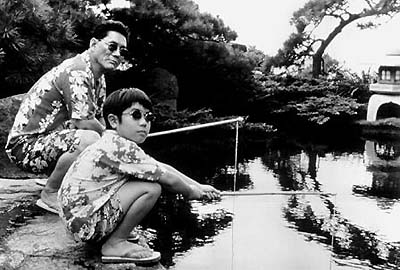
Kikujiro

Considering Kitano Takeshi’s violent films, the last sort of film one would expect him to make, would be a road movie about a kid who travels in the search of his mother. At a first glance, Kikujiro’s plot, may seem redundant and cliché. The story of a boy who goes after finding his mother is indeed repeated through out literature and cinema, but what makes this film, in particular, interesting is how Kitano presents a humor out of such sad story. Kitano himself admits it in the film when “Traveling Man” says: “That stuff happens, all the time in books.” as a reaction to Masao’s failed attempt to meet his mother. Therefore the challenge that Kitano seems to be setting himself in is how he can develop characters and juxtapose events, in order to present a sense of humor out of a tragic story, and also how he can treat violence in order it to become more invisible. All the details within the narrative is indeed so rich and well crafted, that even a critical audience engages himself/herself in the events, rather than trying to predict the rest of the story.
In Kikujiro, the narrative structure is fairly different than the typical three act narrative form. Kitano unfolds his story in chapters and segments. Kitano mentions the reason for this structure in an interview himself:
I gained the strong impression that this film didn’t have the turning point or decisive narrative moment that my other films have had- you could watch the whole thing without feeling that any particular scene was crucial in terms of the overall shape.
Each chapter begins with an illustrative introduction, in which a particular image representing the chapter is decorated as if it is part of Masao’s diary. That is how Kitano wants us to read the film: as a boy’s summer adventure – a story that is somewhat told from Masao’s perspective.
However, on another level of analyzing the narrative form, the film can be divided into two major segments: before and after the moment where Masao meets his mother. This scene does serve as a turning point. Before meeting Masao’s mother both his and Kikujiro’s motivations were to find her. Once they meet the mother and Masao feels rather unwanted, their motivation shifts. Now it is quite ambiguous what their motivation becomes after this moment. For Kikujiro and other adult characters, cheering Masao eventually becomes the driving force and the objective. From this point onwards the narrative gains a more freedom to maneuver. The characters become more entertaining and less bounded to the restrictions that a story might imply. The film eventually becomes a selection of jokes, games and amusing tricks that don’t necessarily follow logic, and are juxtaposed delightfully in an emotional milieu, as if they are part of a boy’s memoirs.
Even though this is a road movie, there is no precise indication about when the actual trip begins. Kitano avoids providing his audience with any reference to neither time nor place. We can vaguely guess how many days the whole trip took, or how far they traveled, not being precisely familiar with the geography of Japan. It is indicated verbally, in the dialogue when the trip begins by Kikujiro’s wife, yet visually it is only after the first gambling scene that we get to see Kikujiro and Masao in a place that is certainly not home, but also doesn’t very much look like a hotel as well. Also by avoiding to provide us with road shots of them traveling to this place, we are left in this bewilderness of whether the journey has already begun or are they still in Tokyo, just spending the money. With these smooth touches Kitano creates a transition between the scenes prior to the trip and the ones during it that almost makes the beginning of the journey seamless.
What shape the narrative structure of this film more than anything else are Kikujiro and Masao’s relationship, and how their characters contrast each other. While Kikujiro threatens, curses, bullies everyone and has a violent attitude, Masao is calm, polite, and obedient. Masao has this strong motivation of finding his mother, and Kikujiro is conceived perhaps somewhat unmotivated. Kikujiro is a middle-aged man with a violent tattoo on his back, whereas in contrast, Masao is portrayed as a cute innocent boy. Kitano perhaps does over-exaggerate this contrast. For example the way Kitano establishes a comparison between Masao’s character in the beginning of the film and other kids of his own age, is an attempt to maximize his innocence, and emotional empathy that the audience might have with him. On the other end, Kikujiro is involved in numerous acts of violence. The image of his face covered in blood is perhaps one of dominant graphical moments of the film.
Looking at the relationship of the two characters, it is likely to say that Kitano is trying to establish an impression that implies a father-son relationship. This is indicated several times within the film, and Kikujiro himself points it out in the form of a joke, to Masao. However, considering Kikujiro’s naïve childish character, Kitano also places scenes within the narrative that suggest, Masao taking care of Kikujiro. For instance after Kikujiro’s fight in the fun fair, when he is covered in blood, Masao desperately searches for first aid material, and cleans Kikujiro’s face. Now this is a very symbolic act, and it not only portrays an emotional connection between the two characters, but also suggests Masao’s thoughtfulness and caring qualities, over Kikujiro’s naïve inner-child. The way they are represented in this scene, gives the impression of Masao being the adult and Kikujiro the child. This notion can be felt through out the film. Comparing Masao’s and Kikujiro’s solutions for getting a ride can be another evident example; where Kikujiro’s attempts are mean and rude, Masao seems to have a much more civilized approaches.
A narrative process that is very likely and favored in the road movies is the transformation of characters, throughout and because of the trip. In Kikujiro this seems to be the case mainly for Kikujiro comparing to Masao, even though it is Masao who is basically the main subject, and motivation for the trip. A direct example of this would be Kikujiro visiting his mother, after Masao’s failed attempt to reunite with his own mother. A clear parallel can be made between the two incidences, and the way in which in both scenes they get to see their mother from a distance and avoid an actual confrontation. Therefore Kikujiro’s visit to his mother can be viewed as result of the reflection of earlier incident in him.
The film has a beautiful touch in terms of its sense of humor. Kitano has managed this connection with his audience by formal techniques that go beyond the content of the narrative. First he does it through editing. Many of the humorous events function simply because of the way images are juxtaposed, and how the relation between them has been established. For example, in the second part of the bike races scene where Masao’s predictions doesn’t turn out to be accurate, we get this constant switch in picture between the boys wrong predictions and failing of the desired bikers. Another example would be the swimming pool scene: Kikujiro first claims that he knows how to swim, he jumps and then swims ridiculously with a tube around his waist. From this shots, which depicts a lot of activity, Kitano cuts to a static shot of Kikujiro upside down in the pool. This stasis provides us with a sense of humor that is beyond the content of the image, and rather a result of wise juxtaposition.
Even though Kitano has tried to produce a less violent picture comparing to his other films, his temptations in adding elements of violence can be yet felt. It is true that he has cut out the direct scenes of violence, and fights, but the evidences of violence exist through the film. For instance, Kikujiro’s character is indeed a very violent one. He constantly shows an attitude towards different people, curses and participates in the acts of violence. He seems to be only obedient to his wife, who sets the trip and forces him to help Masao find his mother. Some characters react conservatively and some violently to his big mouthing.
Kitano smoothens the level of violence in this film using three techniques. First he does it through framing and editing of the scenes of violence. He either lets the violence happen off-screen, or simply has cut the violent scenes out. For instance in the fun fair scene, when Kikujiro and Masao are participating in a game, and throwing rocks at rewards, all we get to see is their feet, standing on stones. Therefore even such action that is less violent in a direct sense has been hidden from the camera. This shows how Kitano is aware of the impact of gestures, regardless of what narratively they imply.
The second method he uses, is balancing the violence mainly expressed through Kikujiro, by other characters, and particularly Masao. As described before, there has been a great effort to show Masao as an innocent cute boy. Next to Masao we also have “Traveling Man” who is depicted as a relaxed, hip person. Even the two chopper bikers who are expected to be though guys, are considerably naïve and obedient.
The third element is perhaps the music sound track. Even though I believe it is too droning and melodic, and its constant repetition, makes it somewhat frustrating, but it does serve in the favor of smoothening the overall impression of the film.
A certain element that is highlighted through out the film, through both mise-en-scene and sound, is the notion of angel. The film begins with the sound of the “angel bell” while Masao is running carrying the backpack with wings that was given to him by the young couple later in the movie. Kikujiro gives Masao the “angel bell” after the failed attempt of reuniting with the mother. This perhaps is to suggest the feeling of the boy towards Kikujiro and others that they meet on the road. Masao probably viewed these people as his guardian angels, and the people who take care of him, regardless of their senses of irresponsibility and immatureness.
By moving beyond a simple plot, developing an interesting narrative form, and by establishing an odd or rather unique relationship between the two main characters of the film, Kitano has taken a courageous conventional step from his typical violent films, and has created a road movie. The sense of humor, which is a result of skillful formal juxtaposition, along with the whole feeling of the film, that implies somewhat a boy’s perspective of life, have distanced it from a violent tragic drama. At the end looking back at the multiplicity of all the different elements and techniques, we can see how they function together to create an amusing and at the same time touching film.

April 02, 2008

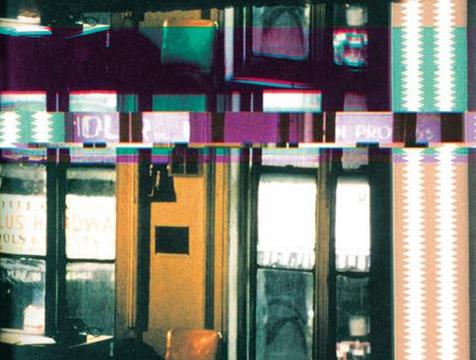
Michel Chion and Michael Snow's Wavelength

Watch the digital version of the film here.

Michael Snow’s Wavelength (Ontario, 1967, 45 min.) has been reviewed and gone under different criticisms, since its production. But critics and theorists have not invested enough attention in analyzing the film through its sonic values. Therefore in this essay, Michel Chion as one of the main figures in cinema theory, who has investigated sound thoroughly, is taken into consideration, and his theories regarding sound and its relation to image have been carefully examined on the way sound operates in Wavelength: the way in which sound adds a value to the image, how it influences the perception of movement and time, how sound functions when it is removed from its source, and finally how different senses transcend the typical sensory system and produce a transsensorial effect.

One of the most vital and perhaps essential films in the history of experimental cinema is Michael Snow’s Wavelength. Screenings of the film have resulted in diverse reactions and experiences, and have triggered more mixed emotions –frustration, boredom, excitement, anxiety and awe– in different audiences than perhaps any other film. It definitely challenges traditional viewing habits, and raises questions and notions on both formal and thematic levels. Louis Goyette describes Wavelength as “a summery of art history which condenses the evolution of painting from the renaissance to the contemporary period, all the while maintaining qualities intrinsic to cinematographic apparatus.”

The film begins with a long shot of a fairly large room, shot with a deep depth of field. The lighting of the room is mainly provided by the natural light, entering through four large rectangular windows, which are at the end of the room, facing the camera. There are also a few florescent lights on the ceiling, which become more effective, in the night shots. The entrance to the room is out of the camera’s framing, but from the flow of characters it can be guessed being somewhere behind the camera on the left.

During the course of forty-five minuets of the film, an extremely gradual zoom-in and in parts track-in takes place. As mentioned, the film begins with a long shot of the room, and then ends with a close-up shot of a photograph on the wall, between the windows, depicting water waves. In addition to this camera movement, there are also textural changes that occur, including subtle and radical changes of color and exposure. There are also black & white shots, different variations of film stock, light flares, day to night changes, visible splices, and negative images.

In wavelength there exists a fine line of narrative as well. This narrative, which is short, comparatively to the length of the film, is kept somewhat abstract, and in parts partially out of frame. There are four human linked events in the film: 1) entrance of a woman followed by two man bringing in a bookcase. 2) Entrance of two women, where one turns a radio on and then off, and the other shuts the window. 3) Entrance of a man, who shortly after falls on the floor. 4) Entrance of a woman who makes a phone call to report the fallen man. The narrative events trigger a shift in the perception of the piece, which is strong and complex on the formal and structural level as well. The audience’s concentration is shifted by these four events, from a formal teleological interpretation of the zoom and the textural manipulations, to the narrative, and vice versa.

More than any other element, it is the sound that shapes the film and creates the necessary relation between the different formal, aesthetic, narrative and contextual factors. However, wavelength has been carelessly described by critics and theorists as a continuous gradual zoom taken from a fixed camera, overlooking the film’s sonic qualities and its effect in the overall experience. In a letter to Peter Gidal on the subject of Back and Forth (1968- 1969), Snow himself did express his frustration with the lack of attention to his employment of sound: “Now as you say seeing the film is a very physical experience. (I can’t understand why you didn’t also say hearing it because the sound, its qualities, relationship to the image, effect, are so important to the whole thing.”

The film begins with the diegetic sound of the location, which is mainly the ambient noise of the traffic outside. Sometimes in parts where the narrative events occur we also get the synchronized sound of dialogues. But the main sound that constitutes most of the film is a sine wave, which begins at around ten minuets through the film. The sine wave starts at a low frequency of 50 Hz and gradually during the course of the film increases its pitch to 12 kHz.
In Audio-Vision Michel Chion introduces the notion of added value¬– an audiovisual illusion in the heart of the most important relationships between sound and image. Chion describes added value as:
…The expressive and informative value with which a sound enriches a given image so as to create the definite impression, in the immediate or remembered experience one has of it, that this information or expression naturally comes from what is seen, and is already contained in the image itself.
The affective influence of sound on image, and the unconscious impression that it leaves on the perception of the motion pictures, acts in two contexts of value added by ‘text’, and the value added by music, as Chion mentions later.

Chion describes cinema as a vococentric or more precisely verbocenteric medium. By this he emphasizes the importance of value added by text, through the spoken voice, or to be more general, language, in cinema. The added value of words can be understood by the way they frame our vision and isolate elements in image. In Wavelength the sound operates on the semiotic level, in two distinct ways, affecting our perception of the visual images. The first and the more apparent one is in the scenes where there are human involvements and we get diegetic sound of spoken words. Those sounds automatically direct our attention towards the presence of the humans, and isolate them from other visual elements in the screen. Now we can argue that this isolation of attention is due to the fact that during most of the film we are viewing an empty room without any human interaction. However in the mentioned events the visuals portraying humans are vague and abstract: characters are visually framed in the dark spots, sometimes partially out of frame, and sometimes under layers of superimpositions. Therefore it can be said that visuals do very little in the process of isolation of attention.
The second and more indirect way in which the sound operates semiotically in adding a value to the image is through the use of a dynamic sine wave. It is quite evident how Snow has used the sine wave as a mean to signify how the film ends. The sine wave which is present almost throughout the film, gains a strong conceptual weight at the end, by the way it highlights the photograph depicting water waves. Here, Snow has played with words and drawn a relation between the image and sound. The sound indirectly by its linguistic qualities adds a value to the image and isolates an element, a photograph– a visual complexity itself.

According to Chion, another way in which sound adds a value to the image is how the sound influences the perception of movement and perception of speed. Chion distinguishes visual and auditory perception referring to their different relationship to motion and stasis. Quoting Chion: “Sound contrary to sight, presupposes movement from the outset. …But sound by its very nature necessarily implies a displacement or agitation, however minimal.” Therefore sound by its very nature has vibrant qualities. However if we avoid physical interpretations of sound and only focus on it perceptive nature, it can be suggested that “fixed sound” is that which entails no variations whatsoever as it is heard. A perfect example of such fixed sound would be a sine wave. Thus the sound that Snow has used in Wavelength is from a “fixed” nature, nevertheless by varying its pitch, and giving it a temporality, Snow has mobilized such sound. Again relating it to the metaphor of wave, it is possible to draw a similarity between water and the sine wave. Water is also by its nature static, but it becomes mobile when it is part of an ocean wave.

Sound can also influence our perception of movement in another manner. It can suggest a movement that is not visually there. A perfect example for this effect, used by Chion, is the sound effect used for the swishy automatic doors in Star Wars saga (Irving Kreshner, 1980), a dynamic pneumatic “shhh” sound. The sound was in fact so convincing that at times the director Irving Kershner, took a static shot of the open door and followed it by a shot of it closed, yet the sound effect which is synced to this cut, gives the spectator an illusion of the movement that is not visually there. In Wavelength, perhaps the ambient sound of the outside traffic suggests such movement, a movement that is not visually there. We never get to see the outside clearly, however because of the diegetic sound of the environment the same kind of infinite temporality that the film has is reflected spatially beyond the windows. Staying in that confined room for nearly forty-five minuets, the sound creates a spatial contrast with the exterior of that location.

This brings us to one of the key notions that Murray Schaeffer has coined, and that is the ‘acousmatic’. Chion defines acousmatic as: “a sound that is heard without its cause or source being seen.” He uses the term acousmatic since he believes both terms, offscreen and non-diegetic, are ambiguous and generally referred to cinema sound. Now the interesting point is that, the acousmatic quality of a sound can only be understood, with its relation to image. In other words, a sound solely by itself has no acousmatic qualities unless it is related to an image, and not necessary an image on the cinema screen. In Wavelength, both non-diegetic sine wave and the diegetic sound of the exterior traffic, have acousmatic qualities. The first one is too abstract to be assigned to any source and the second one’s sources are simply not visible on the screen.

Later in the book The Voice in Cinema, Chion explains two processes of acousmatization and de-acousmatization. acousmatization happens when an image of a sound is removed from it, and vice versa de-acousmatization is when a sound without any image, is given a visual signifier later on. A clear example for de-acousmatization would be when a characters voice is heard offscreen, and s/he enters the frame later. His/her voice is said to be de-acousmatized. Chion assigns a power to acousmatic sounds, a ‘virginity’ derived from the simple fact that its source is not yet inscribed in the visual field. It both challenges the imagination and triggers an excitement for the sound to be known. However as soon as a sound is de-acousmatized, it loses its virginal-acousmatic powers, and becomes a typical image-sound. Snow is very well aware of this power, and he refuses to expose us to the sources of most of sounds in Wavelength. He defines an infinite world outside those windows in that finite space, and creates a metaphor between the sine wave and the waves in the photograph, yet he preserves the acousmatic powers of the sounds and does not reveal their sources.

One of the most important effects of added value is the perception of the time in the image, upon which sound imposes a great influence. Chion uses the term Temporalization for this effect’s process. He then describes ways in which sound can temporalize image: the first is temporal animation of image. Quoting Chion: “ to varying degrees, sound renders the perception of time in the image as exact, detailed, immediate, concrete– or vague, fluctuating, broad.” In Wavelength, even though there are visible cuts, and a cut from day to night, the film gives the impression of being real-time. Chion later on the subject of Temporal Linearization explains:
When a sequence of images does not necessarily show temporal succession in the action it depicts the addition of realistic, diegetic sound imposes on the sequence a sense of real time, and above all, a sense of time that is linear and sequential.
Snow provides the viewer the diegetic sound of the environment, which acts in that accordance, and on top of that the sine wave, even though it is non-diegetic, mainly due to its non-fluctuating quality, linearizes the temporal experience of the image, and gives the image a sense of being in real-time.

The other way in which sound temporalizes image is, according to Chion: “ by vectorizing or dramatizing shots, orienting them toward a future, a goal, and creation of a feeling of imminence and expectation.” In the case of Wavelength, the gradual ascent in the pitch of the sine wave builds up this expectation in the audience. Knowing that this sound is not going to go any higher than a certain pitch, the spectator can vaguely visualize the time when the film is suppose to end. Perhaps a similar feeling to that of viewing a feature length film, where being trained by watching approximately 90 to 120 minuets films, from the beginning of the film we have a quite blurred temporal idea of when the film is going to end.

Chion also analyses the relation between temporalization and sound’s basic qualities such as density, internal texture, tone, quality, and progression. He then names different factors that come to play:
1. How sound is sustained. Chion explains that a smooth and continuous sound is less “animating” than an uneven or fluttering one. At a first glance a sine wave may seem a continuous non-fluctuating sound, but we see that in Wavelength, it perfectly animates the images that are in most parts very difficult to connect with each other. A close hearing of a sine wave will show us, despite our first intake of it, that in fact it is constituted of small cycles of oscillation that occur in the sound. With regards to psychoacoustics, this characteristic of sine wave creates a more tense and immediate focusing of attention on the image.

2. Sound definition. Chion explains that higher frequencies tend to direct perception of the image more acutely, and makes the spectator more alert. This justifies Snow’s gradual tendency towards the high frequency of sine wave, near the end of the film. By the sine wave, he slowly builds up the right tension, and focuses enough attention to expose the photograph.

3. How predictable the sound is as it progresses. As explained earlier, Snow provides the viewers of Wavelength with a sense of time for the film. Considering the threshold of human hearing which is no higher than 20 kHz and the pace of the pitch ascend of the sine wave, the spectator indirectly calculates the film duration and is unconsciously aware. However as the film ends on 12 kHz frequency, Snow conflict that subconscious calculations.

Another key concept that Chion highlights and can be studied in relation to works of Michael Snow and Stan Brakhage, is the notion of transsensoriality. For Chion transsensoriality is that “there is no sensory given that is demarcated and isolated from the outset. Rather the senses are channels, highways more than territories or domains.” He uses the example of rhythm, which is usually thought of as a sonic quality, and generalizes it to other senses:
A rhythmic phenomenon reaches us via a given sensory path– this path, eye or ear, is perhaps nothing more than the channel through which rhythm reaches us. Once it has entered the ear or eye, the phenomenon strikes us in some region of the brain connected to the motor functions and it solely at this level that it is decoded as rhythm.

That is to consider for instance sound and music need not to be confined to the realm of hearing. Brakhage’s silent legacy is perhaps an attempt to produce music with images. He reminds us that because we perceive images with our eyes, we should not necessary draw the conclusion that we can experience it only as visual information. Brakhage states in Film and Music: “I seek to hear color just as Messiaen seeks to see sound.” In Wavelength, transsensoriality is evident in both directions. While the image provide us with a rhythm and musical sensation, the sine wave and the offscreen sounds illustrates an image for our mind; an image of spatial eternity beyond the windows, and at the same time a sensation of temporality.

As it is illustrated above through Chion’s different notions of sound and its relation to image, the sound in Wavelength, operates at different levels, and plays a significant role in contributing to the experience that this film leaves on its spectator, after forty-five minuets of patient viewing. It adds a value on both semiotic and sonic levels to the image, it influences the perception of the movements, and gives a unique temporal quality to the film that is certainly one of the most effective parts of the whole experience. The film presents us with sounds whose sources are never exposed, thereby creating a powerful tension that never goes away. The visual and sonic qualities of this film certainly cross their own sensory organs and create a transsensoriality, a phenomenon that connects them, and creates a powerful film.

March 08, 2008

Hollywood: the Propaganda Machine of US in WWII

One of the most important weapons that all major countries involved in Second World War used was propaganda, and perhaps the most suitable medium for it was cinema, mainly due to its visual appeal. Not long after Pearl Harbor Roosevelt’s government established the Office of War Information, which was acted as a liaison between Hollywood and government in homogenizing the act of propaganda. Cinema of the World War II in the United States operated certainly on much higher level than simple escapist solution. It touched a subconscious level of an audience, which were in thirst of information about a war that mostly took place away from the homeland.

According to Richard Taylor: “propaganda is the attempt to influence the public opinions of an audience through the transmission of ideas and values.” By using the word attempt Taylor suggests that nature of propaganda in which there should be a purpose. What separates propaganda from other political and social activities is that it pursues a purpose, and a political direction. A propagandist should precisely know the values s/he tends to transmit, and her/his audience’s existing opinions, values, tastes, and needs, in order to establish a connection with her/his audience. For this very reason Taylor dismisses the possibility of the unintentional or accidental propaganda. Regardless of how an artwork might be influential, it only serves as propaganda if it pursues a purpose, or if it is put, by the propagandist, in a context that serves the purpose.

In such a context in which the purpose of the propaganda serves as its core element, it is also important that, the purpose would be kept concealed from the audience. It was Goebbels who once stated: “ Propaganda becomes ineffective the moment we are aware of it.” It is required and absolutely essential for propaganda, in order to be effective, to conceal its origin or sources, the interests involved, the methods employed, the content spread and the results accruing to the victims.

Considering some of the qualities of propaganda described above, it is relevant to reflect on the reasons why cinema above all other mediums, was the main apparatus of propaganda during the Second World War. At that time, cinema was perhaps the most popular mass medium. While the press, only appealed to a certain group of the society, cinema, on the other hand, drew its audience from all different social classes and groups. It gathered them all under one roof and allowed them to share reactions to a particular picture, or in other words, cinema allowed different classes to influence each other’s viewings of a picture. Cinema was less demanding, and easier to comprehend, but above all it was the power of the visuals that made the cinema the most attractive. According to Tylor, the visual appeal operated on the emotions rather than intellects, and it touched us at a more primitive, subconscious level. From the perspective of the propagandist, cinema, provided control over content more than any other medium, and at the same time provided much more diverse variety of possibilities. What was being captured, the position of the camera and how it depicted its subject, the relation between images that was provided by editing, the added value of the voice over narrations and etc., all assisted propagandist in developing her/his desired affect.

***
Quoting Clayton Koppes: “When war broke out in Europe in 1939, the United States was the only major power without a propaganda agency.” But even though there was no precise institution in charge of propaganda before Pearl Harbor, the Motion Picture Committee Cooperating for National Defense existed, which was responsible for the distribution and exhibition of national defense films, produced by governmental bureaus. These films included the recruitment films seeking volunteers to serves the military forces and workers for defense oriented industry.

Roosevelt’s first attempt towards establishing a propaganda agency was when he ordered the creation of the Office of Government Reports (OGR) in the late 1939. The president assigned Lowell Mellett, the former editor of the Washington Daily News, as the head of OGR. The agency was mainly responsible for putting the information in a context that serves in boosting the public’s confidence in the military power. OGR was in charge of assuring an atmosphere that would be supportive of the president’s international policies. Citing Koppes: “ the office assumed that if such information were readily available, the private media could be counted on to use it –– a strategy that worked well.”

From that point till the June of 1942, which marked the establishment of the Office of War Information, several information agencies were founded. These institutions, which in some cases had parallel responsibilities and interests, were mainly engaged in production, exhibition, distribution of propaganda material, or the treatment and censorship of the information. Among these institutes was the Office of Coordinator of Information (COI). Made of much stricter personnel, COI was created by executive order in July 1941. COI was mainly committed in producing psychological warfare and confrontational propaganda. This type of propaganda required covert actions such as black propaganda, or what we now call disinformation, skillful use of rumor, deceptions and lies to generate confusion and defeatism among the enemy. And we have to remember this is four month before the Pearl Harbor incident.

With the establishment of such organizations and reactions in Hollywood similar to that of Twentieth Century-Fox chief Darryl F. Zanuck , which frequently spoke in the favor of America’s Entering the war, the isolationists’ frustration was resulted. They accused Hollywood of initiation of a devious campaign to inject its entertainment pictures with propaganda and eventually draw America into a war. However it is also worth mentioning that in three years between Munich and Pearl Harbor, out of one thousand films produced by Hollywood, only fifty had anti-Nazi theme. The majority of the films were non-controversial pure escapists.

In the June of 1942 the Office of War Information (OWI) was established by the government, as a single central liaison between Hollywood and Washington, mainly under the influence of Mellett. OWI budgeted and produced different variety of films. It reviewed and made “suggestions” to the producers. It impose a control over the import and export of the movies, and it provided the armed forces with films, varied from pure escapists to serious educational training films.

On the top of OWI, pentagon imposed its own restriction and censorship. Almost any film that involved the armed forces, Navy or the Army Air Corps in a major way had to go to pentagon, to seek the military’s approval. Each film was checked for the accuracy of the uniforms, insignias and traditions. But obviously it was much more than that, as all the scripts were read before the official approval was given. They made sure that the picture was not harmful to the military’s interest. In return the military provided the film crew with the professional and equipped personnel to assist them in the staging of the battle and camp scenes. The pictures were absolutely dependent to this crew, and the savings in the production cost could have been enormous.

By the summer 1942, when America was already in the war, OWI articulated a guideline for Hollywood called: “Government Information Manual for the Motion Picture Industry.” In this manual OWI highlighted five major aims, which motion pictures needed to take into consideration. Understanding and probing these five element will helps us identify OWI’s main intention and also its comprehension of the American public. It will tell us a lot about what American audience expect from the motion pictures and at the same time what the government wanted to transmit to the public.

1.Why We Fight: In order to justify American presence in war, and also accentuate the patriotic emotions in the public, government and consequentially OWI, were keen on one word more than any other: “democracy.” The flexible term was used as a precious value common between the Allies and perhaps what they fought for. The war was put in a context where it would appear as protection of the American democracy.

Besides the notion of democracy, other values were as well meant to be highlighted. The government wanted to advertise the war as “a people’s war.” Therefore it was keen on depicting and emphasizing the American way of life and “democracy at work.” The pictures showed everybody contributing according to her/his ability regardless of her/his class, ethnicity, or religious identity. It was advised by the OWI to avoid absolutely any stereotypical depictions.

The Pearl Harbor incident, as what initiated the American involvement in the war, was over emphasized. In fact the Japanese were victims of United States propaganda, much more than Germans.

2. Enemy: while American and the Allies resembled the essence of righteousness, the enemy stood for all evil. There were two major issues regarding establishing a general standard of enemy depiction. First who was enemy? Officially Roosevelt administration considered the Axis governments and not their people as the enemy. But motion pictures needed a less abstract, and more visual examples and guidelines for depiction. The second issue was to define fascism. They knew that the enemy was not the entire Germans, Japanese or Italian people, but rather the ideology that seeded the evil doctrine of hatred. But the bureau was still unclear about what fascism was, and who was a fascist, and it sent vague messages to the motion pictures.

However after studying several films of the wartime, Joe Morella draws a general conclusion about the stereotypical portrayals of the enemy in the motion pictures. Germans were regularly portrayed as cultured swine; they could be brutal but were intellectual about it. Japanese were shown as fanatical savages, devious, filthy fighters. In the early war some Hollywood pictures made reference to the Japanese as the “yellow cowards” and “yellow rats” but not very long after the producers were reminded that Chinese, the American’s allies, were also yellow, and might not like racial slurs. As mentioned earlier Japanese were given a much more cruel and brutal image in the films mainly because they were depicted as the ones responsible for United States involvement in the war.

But why was it so important to have a guideline for the way enemy was shown in the motion pictures? Due to the fact that war, at least in most parts, occurred away from the American homeland. The American public showed an interest in knowing and recognizing their enemy. At the same time the troops had to have a knowledge about who they are fighting against, and what ideology it is that in order to resist it they should risk their lives. Having said the sophistication of enemy’s description, such guideline was perhaps considered necessary.
3. The United Nations: Thirty nations were allied against the Axis. The manual homogenized them as anti-fascist democratic societies. The notion of democracy as the bounding value between the allies was over emphasized, even though the communist USSR was among the thirty nations. The manual’s strategy towards this issue was: “Yes, we American reject communism, but we do not reject our Russian ally.” said the manual.

As much as the American public wanted to know their enemy, they showed interest in learning about their allies in the war. The also found it extremely important strategically and also in terms of the increase of the morale, to educate the armed forces about the allies. Perhaps it was for this very reason that Frank Capra, decided to devote three out of seven episodes of his non-commercial government-sponsored propaganda, Why We Fight (1943-45), introducing Britain, China and Russia.

4. The Home Front: Americans certainly didn’t feel the pressure of war as much as some other allies. a notion, which was suggested by the manual to be highlighted, was civilians’ responsibilities during the war. It advised the motion pictures in showing everybody living their normal life while cheerfully their bit for the war. Also any kind f imagery or use of elements that suggested unity and triggered common emotions was encouraged.
5. Fighting Forces: Studios were encouraged to consider battle scene, more than just melodramatic segments of the narrative, rather a good reference for how the armed forces are engaged in the war. OWI urged the filmmakers to stress out all components of the armed forces. By this, Firstly, the public would have gained a reassurance of the strength of their country’s army. Secondly this kind of imagery will prepare them for casualties. And thirdly, to develop more dislike towards the enemy.

These five major factors were taken into consideration by most pictures, and were applied to all propaganda films, accordingly in their variety of genres. This included war documentaries, newsreels, training films, recruitment films, Narrative with war related subjects. The training films were made in order to educate both armed forces and the industry. These films were effective to an extent that General Eisenhower during the war made the statement that “training films had cut the actual training period to an extent that our army was better equipped to fight far sooner than they would have been without what was done by the film industry.” Out of all the newsreels seemed the most untouched and factual of all. However they were highly censored. Over fifty percent of the footage taken by Paramount was deleted and only impounded in government vaults.

As it is illustrated above, government of the United States used all his power, to impose its control over the cinema during the war years. Because of its, visual appeal, accessibility, and ease in its comprehension, cinema was truly the perfect mass medium of the propaganda, during the Second World War period. Even though it took almost a year of confusion in the information sector for the OWI to be established, but it certainly did acquired a respectable amount of authority over what was being produced in Hollywood, over a short period of time. The release of the manual and guideline for production was another step towards systemizing and homogenizing the war propaganda products.

Even though such restrictions were imposed, and the government started charging 20% admission tax, there was an incredible increase in the number of the moviegoers. In 1944 almost 100 million Americans (two third of the population) attended movies each week. With regard to what was illustrated before, we can conclude that the cinema during the war, was much more than an escapist solution. Considering the fact that most of the war happened away from the homeland, we can argue that the American public was much more in need of information, rather than escapism. The high attendence then perhaps was to watch the war news, and acquire information about the enemy and the allies, and of course noting the guidelines, most film were produced in a way to execute the job of boosting of the moral.

References:
Brady, Thomas. “Newsreels and The War.” The New York Times. Jan 12, 1941.
Ellis, Jack C. “ Why We Fight.” International Dictionary of Film and Filmmakers. Vol.1, pages 976-979.
Farber, Manny. “With Camera and Gun.” The New Republic. Mar 23, 1942. Vol. 106, page399.
Koppes, Clayton R., Gregory D. Black. Hollywood Goes to War. The Free Press, New York, 1987.
Manvell, Roger. Film and the Second World War. J. M. Dent & Sons Ltd., London, Great Britain, 1974.
Morella, Joe., Edward Z.Epstein, John Griggs. The Films of World War II. The Citadel Press. Secaucus, New Jersey, 1973.
Taylor, Richard. “ Propaganda and Film.” Film Propaganda. Harper and Row Publishers, Inc., New York, 1979. Pages 19-33.
Thompson, Kristin., David Bordwell. “Wartime Documentaries.” Film History: An Introduction. Ed. 2nd. McGraw-Hill, New York, 1994. Pages 313-317.

February 05, 2008

Band of Outsiders

Jean-Luc Godard made Band of Outsiders (1964), in his early years of cinema production. Godard has carefully orchestrated different mise-en-scene elements and juxtaposed narrative structure, in order to develop the characters, polish a very simple story and establish a mood in this Black and white picture. His little touches and memorable moments make the picture much more than a simple gangster film. The ambiguity of characters and the oddness of the many elements through out the film create an interesting result. In the following essay the film is analyzed through the perspective of both mise-en-scene and Narrative form.

The film takes place mainly in the outskirts of Paris, in winter. The harsh raw portrayal of Paris suburbs, distances this film from the typical summer romantic clean Paris images. The cloudy, dirty wintery roads and the harsh existence of materials such as the cable spools in the muddy industrial ‘other side of the river’, all together contribute in setting the appropriate atmosphere.

The realness of the images leaves an impression similar to that of documentary films. Almost all of the scenes are shot in real locations. It is event that through out the most of the film, natural lighting has been favored very much. Using the available sunlight, Godard has carefully composited his images, in a way that elements still serve their function. For instance in the English classroom scene, the black board is placed between the two windows, in a way that, when the teacher stands in front of it, facing the class, the light coming from the windows shines on her back which creates a soft light and glorifies her and stresses her posh gesture.
The make-ups are minimal, and they have been done in a seamless fashion, so they won’t drag much attention, remain consistent within the films realness qualities, and function in depicting characters. For example Odile’s make-up is reduced to black-eyeliners, which helps in creating an emphasis on her eyes; what she uses a lot of times to express herself. Odile’s short bangs and hairstyle along with her costume which is very identical to school uniforms, portrays her naïve and childish image. Comparing Arthur and Franz’s appearances, an impression of their differences can be felt. While both are clean cut, Franz seems more fashionable, formal and uptight, especially considering his styled hair cut, and athletic body. On the other hand Arthur’s comfortable, normal clothing and his short hair, suggests rather coolness in his portrayal.

One of the key mise-en-scene elements, seen constantly throughout the film, is “the car” that Franz and Arthur ride. Many of the character dialogues take place in the car. The fact that the car is a topless convertible creates an interesting composition setting, where the background of the characters is a constantly changing sight of Paris. On another level the car also contributes to the narrative: when Franz, Arthur and Odile are riding the car with its roof off in the rain, A kind of bizarre abnormality is presented.

Another important mise-en-scene element, which has been used very frequently, is mirror. The main implication of mirrors is mainly to widen the range of view within the frame, but in Band of Outsiders it is also used in helping character development, and narrative indications. Odile constantly checks herself in the mirror, whether it is the small mobile one that she carries, the one on the wall in the cafeteria, or the one in the cafeterias restroom, which is to suggest Odile lack of self confidence and at the same time a kind of teenage narcissism. We also get to see Mr. Stolz’s jacket in the tall mirror placed next to the closet containing the money; The same jacket that later on causes the setback, and as the result a change, in their rubbery plan.

The character movements and positionings has been well planned in most scenes, and their added value to the narrative is worthy of note. For instance the exchange of the drinks in the cafeteria; the never ending dance, that all three of them strangely do it very well in harmony; or the way they roam around the house with their face covered in black socks, in the scene where they enter the house for the first time. They almost seem to mesmerize the camera, which remains at one place and only tilts and pans to follow their fast enterings and exits.
It is very likely to say that an essence of Brecht’s epic theater is sensible in the actors’ performances. According to Britannica Encyclopedia Epic Theater or Brechtian distancing:
“[…] Blocks audiences’ emotional responses and to hinder their tendency to empathize with the characters and become caught up in the action. To this end, Brecht used “alienating,” or “distancing,” effects to cause the audience to think objectively about the play, to reflect on its argument, to understand it, and to draw conclusions.” 1

The acting style, narrative structure, character motives and dialogues all suggest that Godard was not interested on the psychological believability of his characters. The alienating effect is evident through out the film and its tension in some points is highlighted, and prevents us from emotional involvement and reminds us of the cinematic qualities of the film; acts such as Odile’s feeding the tiger; her stare in the camera; the ride in the roofless car with wet windshield and operating wipers, while there are no evidences of rain; Arthur’s very realistic long reaction to fake mockery Franz’s hand-gun shots; the one minuet of silence which totally cuts off the sound and mixes the digetic and the non-digetic worlds; or perhaps Arthur’s gun fight at the end with his uncle where he receives dozen of bullets, and only dies after he kills his uncle with only one shot.

In terms of the narrative structure, Band of Outsiders follows a simple plot, which is based on Fool’s Gold novel by Dolores Hitchens. What makes the film interesting is Godard’s juxtaposition of odd events in between the storylines. He develops his characters with care without giving too much away, and maintaining their ambiguity.
All characters face a transformation as their roles develop and they get closer to their objectives. Odile, which is first, portrayed as a naïve, uncertain teenage schoolgirl, eventually turns into an assistant in the crime, and reveals the adventurous side of her. Yet at the end when the both robberies fail, she expresses frustration and regret.

Franz and Arthur have almost the same motives. Both of them are after Mr. Stolz’s money and both fancy Odile. While Franz is in love with Odile and therefore is tongue-tied around her, Arthur, whose intention towards her is rather that of lust, seduces her with his smoother flirtatious language. As the robberies fail Franz and Arthur’s real intentions toward her get revealed. While Arthur turns into a cynical tempered character that blames Odile harshly, Franz shows his kindness and calms her down.

One of the interesting features of Band of Outsiders is the third person omniscient narration, which is done by Godard himself. The disjointed Narration covers a wide range of approaches in different scenes. He sometimes uses an ironic and humorous language, while being poetic at other times. At times it expresses character’s inner feelings, or provides absolutely unnecessary statements, or rather leaves comments on the cinematic aesthetics of the film. Godard’s fine line of humor in the narration creates a sense of parody of the typical Hollywood third person narrations.

The film includes a series of playful set pieces, which as narrative techniques function along the Brechtian distanciation, to create the interesting character ambiguity, and also the odd unusual nature of events: the long citations of Shakespeare’s “Romeo and Juliet” in French, in the English language class; the symbolic race in the louver museum, and shown particularly, in the classical paintings section, which is a humorous demonstration of the absolute ignorance towards ethics and standards; the repetitious never ending dance; Frantz’s pause in the midst of the robbery to swipe a book;

Placing the film within Thompson’s four-part structure, in the first act Odile, Franz and Arthur’s relationship with each other are exposed. Also their main motive as protagonists, which is to rob Mr.Stolz’s illegal money is introduced. The first act ends as the three main characters leave the English class, with humorous Godard’s voice-over narration over the images, explaining why the actual act of leaving the class has been cut off. In the second act the characters are developed as they plan the robbery, and at the same time hang out in a cafeteria and call off the night with a coin toss, which decides a person between Franz and Arthur, that Odile would spent the rest of the evening with. This leads to the first major turning point at almost the halfway mark, which is the departure of Odile from Arthur’s place, and his struggle with his uncle over the informations regarding the money. The first attempt of the robbery, which fails, leads us to the climax, which ends the third act. After the verbal talk between Arthur and Odile, which upsets Odile, the turning point between the third and the fourth act is indicated by extreme long shot views of the Paris landscapes, with voice over narrations on the top. In the fourth act the film concludes with the second robbery attempt, which also does not go very well. By the end the film ties up all the loose strands and leaves no unanswered plot questions, or unclear issues.

Godard has used all the available resources, to create the appropriate mise-en scene, and craft the plot. He has shown that it is possible to create an interesting image using basic available raw martial, simply by integrating them within an interesting yet questionable composition, also inserting unexpected elements in the narrative structure, and Brechtian Distanciation, in order to produce something far more remarkable than a typical gangster film.

1 "epic theatre." Encyclopædia Britannica. 2008. Encyclopædia Britannica Online. 9 Jan. 2008 .


December 01, 2007

Zizek, Casablanca and Post-Code Hollywood

Watch the Video Here


Slavoj Zizek is a Marxist/Lacanian psychoanalyst. His psychoanalytic observations of Cinema is very interesting and different. In this video he briefly talks about Casablanca, one of those mediocre Hollywood hits that to my opinion has been over-rated. He also approaches the Post-Code Hollywood censorship, on the level of its subconscious affect.

I really encourage you to check other Zizek videos on youtube. There are two full length features also called: the reality of the virtual and Zizek, that are really interesting.

November 30, 2007

My Man Godfrey and The Great Depression

Gregory La Cava’s My Man Godfrey (1936) was released in the midst of the Great American Depression. Like many other films of this time, My Man Godfrey served as an escapist solution for the lower classes that struggled with unemployment, specially that the hero was someone they could relate to. My Man Godfrey points the finger at the government and the snobbish higher class, as the main reason for financial hardships and It offers an amusing comedy that concludes in the prosperity of the poor.
The Depression’s social consequences, such as unemployment, bankruptcy, poverty, and clashes of social classes, are some of the main elements that shape the narrative. My Man Godfrey looks at the Depression from the perspective of the rather elite class. On one hand the film is extremely critical of the high society and it represents them as “empty-headed nitwits” through a comic portrayal, and on the other hand it reveals the people in the dump, who are tagged “forgotten” by the rich, as what Godfrey (William Powell) calls: “the society of really important people.”My Man Godfrey is formed around the comic divergence of Godfrey Parks with the negligent upper-class Bullock family. The Bullock family is symbolized as the mindless partying, irresponsible elite who belong to a class that are too occupied by leisure and are somewhat the answer to the unemployment. Mrs. Bullock (Alice Brady) is portrayed as an unintelligent “amusing” person who supports his protégé Carlo (Mischa Auer) , a pianist whose responsibility in the family is rather that of a royal joker. The cold monstrous older daughter Cornelia (Gail Patrick) is described by Godfrey as:
the Park Avenue brat. A spoiled child who's grown up in ease and luxury, who's always had her own way, and whose misdirected energies are so childish... that they hardly deserve the comment even of a butler on his off-Thursday.
The childish and naïve Irene (Carole Lombard) steals a horse from a cab and leaves it in the family library. Mr. Bullock (Eugene Pallette) however seems to be the most rational of all, yet a shareholder whose mediocre understanding of the stock market almost results in his bankruptcy.
The bullock family’s involvement in the scavenger hunt is also to emphasize their idiocy. The inanity of the game and their treatment of the poor illustrate the boredom and silliness of the high society of the time and comically criticize its snobbish intellectualism. The scavenger hunt creates a contrast between the two extreme social classes, the poor in the dump and the elite. While the rich are in search of “something that nobody wants-a forgotten man” just as a matter of amusement, the poor must also scavenge among the rubbish, rather as means of survival. The destiny of those who participate in this game is clear, when Irene explains to Godfrey that not all of them are hunters, but some are receivers, he suggests: “Sounds like a bankruptcy proceeding.”
The film criticizes the wealthy class and holds them somewhat responsible for the misfortunes of the poor, not because of their wealth but rather their arrogant, irresponsible behaviors. For instance in the scene where Godfrey for the first time as the butler serves Mrs. Bullock’s breakfast, she is unable to recall him:
- What's your name?
- Godfrey.
- Are you someone I know?
- We met last night at the Waldorf Ritz.
- Oh, yes, you were with Mrs. Maxton's party at the bar. Or were you?
- I'm the forgotten man.
- So many people have such bad memories.
It is suggested that people like Godfrey have become “forgotten” mainly due to the negligence of the ignorant upper class that are deeply involved in their leisure life. Another example would be Mr. Bullock’s suspicious first encounter with Godfrey. Even though Godfrey is well dressed and relaxed, Mr. Bullock identifies him as a burglar, which indicates not only Mr. Bullock’s suspicious nature but also his superior power over Godfrey. Cornelia’s constant act of humiliating Godfrey to the extend of setting him up for a theft of her pearl necklace, was also along the lines of snobbish higher class cruelty towards the poor. Even Irene, who is in love with Godfrey, finds herself in a superior position over him. She stubbornly obliges Godfrey to love her throughout the film and at the end she marries him by force. By mostly framing her higher and on the left of the Godfrey, the dynamic forces of power are suggested.
The film is also critical of the government interference in the crisis, and shows a preference for laissez-faire instead. In the very opening scene a tramp complains to Godfrey about the police intrusion in his business: “ If them cops would stick to their own racket and leave honest guys alone, we’d get somewhere without all this relief and stuff.” We see that at the end the survival of the forgotten men from unemployment is because of Godfrey’s project which does not involve any welfare or governmental funding. My Man Godfrey also deals with the notion of tax in wealthy families. In the scene where Mr. Bullock warns the family about their spendings, so that he would be able to pay the taxes, the family reacts to the high percentage of the tax taken by the government. Mrs. Bullock argues: “Well, why should the government get more money than your own flesh and blood?” what is evident in this scene is that the wealthier families are also being effected by the Depression, where at the time it is not taken seriously by the family members, as they are far detached from reality, living in their world of leisure.
The film offers a rather capitalist conclusion to the crisis. Godfrey, with the help of his friend Tommy Grey, finances a project where he not only provides jobs for the forgotten men in the dump, but also saves the Bullock family from bankruptcy, due to his understanding of the market. The conclusion suggests that it is Mr. Bullock’s wrong decisions that result in his bankruptcy rather than the harshness of the stock market. By transforming the dump into a nightclub, Godfrey creates the means to earn money and benefit the poor, out of the snobbism and desire for leisure of the high society. The very act that through out the film was demonized and held responsible for the forgotten men’s misfortunes has become their survival solution.
According to Peter Roffman and Jim Purdy, Godfrey’s psychological state is a metaphor of the country’s condition. He has coped with his Depression by joining the common people in the dump. Godfrey describes his experience to his old time college friend Tommy Grey:
when you begin to feel sorry for yourself. And boy did I feel sorry for myself! I wandered down to the East River one night, thinking I'd just slide in and get it over with. But I met some fellows living there, on a city dump. They were people who were fighting it out and not complaining. I never got as far as the river.
The character of Godfrey Sympathizes with, and praises those who struggle through financial difficulties and poverty, mainly due to the Depression. His perfection at work and his effort in being a “GOOD butler,” shows not only his disciplined attitude, but emphasizes his need for the job as well. While visiting the dump with Tommy, which looks even filthier in the daylight, Godfrey stresses the importance of the employment: “the only difference between a derelict and a man is a job.”
Apart from the fact that movies like My Man Godfrey were an escapist solution for the audience, from their troubles and financial difficulties, they provided characters that people could relate to. While everybody blamed a different person or organization for their financial hardship, My Man Godfrey depicts a certain class and points the finger at them and the government state. Following the destiny of a poor forgotten man, the film fulfills the lower class’s fascination with the wealth, by setting the plot mainly in luxurious locations. The film concludes in a way that provides hope, the capitalist solution, which seems to be the only way of having everybody, both wealthy and poor, happy.

November 21, 2007

New Look, New Policies

Dear Visitors,

I appreciate all your support. I know I don't have that many frequent visitors, and I know the reason. As my variety of submissions are very wide, I get a lot of one time visitors and not many returning ones. So as of now I will categorize the postings in different genres, which are: Cinema, Music, Visual Arts, and Philosophy.

I am happy to have visitors from as far as Saudi Arabia, and Chile. I hope you find the material here helpful to your research and/or curiosity.

There had been also a funny incident. Something like 4 month ago I had a posting on Guerrilla Girls, and in that post there was a non explicit image which was called nude.gif, now because of this image the traffic to my blog has been almost tripled. So a special thanks to perverts for boosting my google location! :)

November 11, 2007

A historical Look at the production of Munau's "The Last Laugh"


The Last Laugh which had the original German title of Der Latzte Mann- Like the French title Le Dernier des Hommes- was an exteremely well appreciated and valued Film at the time. Bioscope called it: “the greatest film ever made” or referring to The Times, it was “unusually good.” It was the collaboration of three men, F. W. Murnau, Carl Mayer and Karl Freund, which resulted in a picture that with almost no inter-titles managed to be still intriguing and simulating.
The Last Laugh is a portrait of an elderly doorman, who identifies himself with his uniform. Once this uniform is taken away from him due to his age incapability, he finds himself depressed, destroyed and low. Especially that he is transferred to lavatory services, forced to wear a new mediocre white coat.

The story of The Last Laugh is simple, yet the context, in which it is represented in, is complex. The social cruelty that the film criticizes is not presented in the plot, rather in the impressions that the whole complex cinema visualization will leave on the mind, as well as social consciousness. “It is less a narrative of occurrences than a record of psychological experience.”
Although at the time of the screening of The Last Laugh, most of the credits were given to Murnau, scenarist Carl Mayer played an important role in the development of the film. Mayer wrote Scherben and Sylvester, the first two of the Kammerspielfilme trilogy, both directed by Lulu Pick. His disagreement with Pick resulted in Murnau directing The Last Laugh. Quoting Barton Palmer: “Murnau more than Pick was able to realize Mayer’s ideas about dynamic and flexible point of view.” Because of Murnau and Mayer’s understandings of each other The Last Laugh as an outcome was both technically and aesthetically brilliant.
More than anything else this film has been praised for its great use of mobile camera, a concept very new at the time. The Last Laugh’s reputation for great cinematography was a result of Mayer’s concern in writing for camera, describing in details perspectives, positions and movement , also, Murnau’s awareness of camera aesthetics and Karl Freund’s techniques. The utilization of a fully automatic camera, capable of all sorts of movements, enables Murnau to create Mayer’s desired fluidity in the title-free narrative structure.
Murnau and Karl Freund introduced the entfesselte or the “unchained camera”. Murnau employed this technique to create the famous drunk scene, illustrating porter’s distorted, dreamy vision. Freund achieved this kind of picture by attaching the camera to his chest using straps and staggering around the set. In the opening scene, the camera descends in the elevator, goes through the hall way and then exits the hotel entrance to where porter stands, having it all in a long traveling shot. According to Palmer: “Freund achieved this effect by mounting the camera on a bicycle. Another extraordinary shot was the passage of the camera through the glass wall, which was achieved by a discreet dissolve in the montage. Murnau also beautifully showed the movement of sound through camera: the trumpeter turns towards the camera, in a way that the opening of his horn fills the frame, then the camera tracks backward quickly, as if the sound of the trumpet was flying. Same method was used in the scene where the doorman’s neighbors shout the news of his degradation.

The Last Laugh’s set was entirely studio-built, and the whole film, except for the shot in the railway station interiors, was staged there.
What Mayer called ‘in Licht und Glanz’ in Sylvester, which means ‘luminous and resplendent’, was dramatically taken to another level by Murnau: The movement of flashlights, the reflective black oily and wet raincoat, glass surfaces with glitter, shinny coat buttons or the lighted windows of the apartments. Quoting Marc Silberman:
“Light here is not the reflection of an outside source or even an ornamental element but rather suggests in its intensity and dispersal another world, he unseen world of darkness and shadows opposed to such clarity.”
The objects as part of the mise-en-scene play an important role in the narrative structure of the film. For instance the doorman’s obsession with mirrors and the constant act of checking himself in them, which signals his crises over the notion of self-knowledge, or the use of swinging door for creating the ‘expressive framework of the protagonist’s actions’ . But more than anything else it was the doorman’s uniform that contributed to the narrative. Served as a symbol of authority, power and respect, it determined the doorman’s high “rank”(Stand) even though he was from a lower “class”.

Emil Jannings who played the role of the doorman, received a large amount of publicity at the time. Jannings, who was already well known in UK and US for his performances, was a key factor in the plot progression, especially that there was no inter-titles and everything must have been acted out.
One of the interesting instances that happened during the production of The Last Laugh was Hitchcock’s encounter with Murnau. Hitchcock who visited Berlin as an assistant director of an Anglo-German production, filming The Background at the UFA studios, was situated in the neighboring set to Murnau. Hitchcock carefully observed Murnau at work, and was fascinated by his methods. In an afternoon that Murnau and Hitchcock spent together, Murnau “proceeded to point things out” to Hitchcock, such as the use of the perspective.
It was Murnau’s Sense of direction, along with Mayer’s imagination and Freund technical creativity that created the appropriate fluidity in a film with no inter-titles. The mobile camera was a great asset in creating the flow, in a narrative story that was simple, yet complex in context.